Wiwaxia
Reborn as Wiwaxia, you would be a slow, armoured grazer about the size of a large almond, wearing a coat of chain mail and a crest of blades.
Chain mail and swords
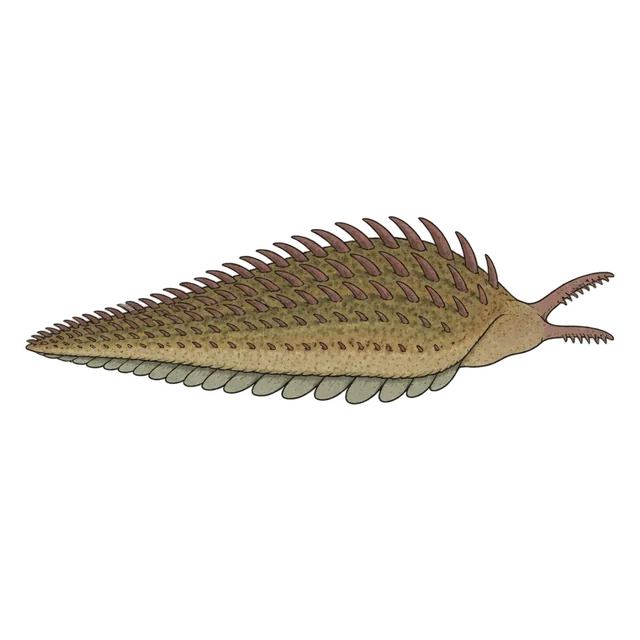
Wiwaxia was a flattened, oval animal usually no more than about 5 cm long. Your upper surface was covered in rows of small, overlapping scales called sclerites, each set into the skin like a shingle. Along your back rose two rows of long, blade-like spines, angled outward like a hedge of swords.
Your underside was soft and scale-free, a muscular foot for creeping over the sea bottom. Fossils of young individuals show that the scales and spines were added and replaced as the animal grew, rather than growing with it.
Grazing the slime
Cambrian seafloors were often carpeted with mats of bacteria and algae. Wiwaxia had a feeding apparatus with two or three rows of tooth-like structures, which many palaeontologists compare to the radula, the rasping tongue of snails. You would scrape the mats as you went, a living lawnmower on a slimy lawn.
The spines were your answer to predators. Some fossil spines are broken, possibly from attacks, suggesting the armour was put to real use.
Mollusc or worm?
Wiwaxia was described by Charles Walcott from the Burgess Shale of British Columbia, about 508 million years old, and has since been found in Cambrian rocks in China as well. Its place on the tree of life is still argued over. Many researchers see it as an early relative of molluscs, based on its tongue-like teeth, while others have linked it to bristle worms because of the structure of its scales.
Whichever answer is right, Wiwaxia shows how early animals experimented with armour long before shells of the modern kind were common.