Tiktaalik
As Tiktaalik you would be a fish with a neck – lurking in warm Devonian shallows, propping yourself up on sturdy fins and peering over the surface like a crocodile.
Half fish, a bit tetrapod
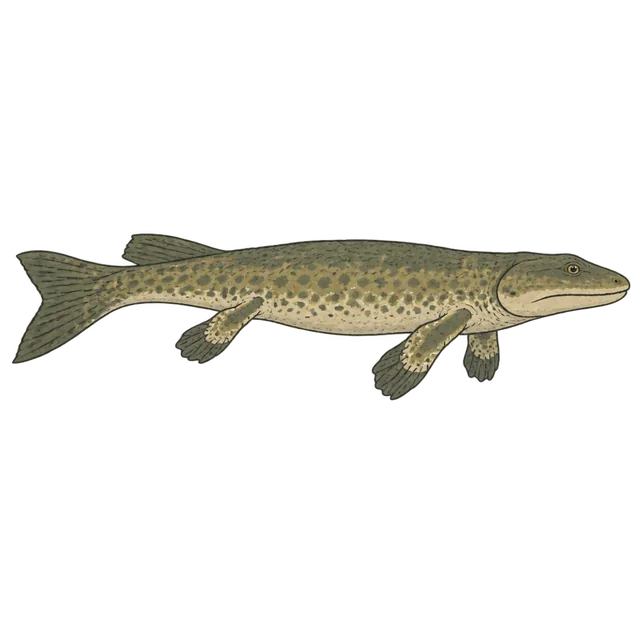
Tiktaalik roseae was a lobe-finned fish with features pointing towards land animals. You would have scales, fins and gills, but also a flat, broad head with eyes on top, a mobile neck (your head was not fused to your shoulders as in most fish), and robust ribs. Your front fins contained bones equivalent to an upper arm, forearm and simple wrist, strong enough to push your body up from the bottom.
Spiracles on top of your head suggest you could gulp air, and you probably had lungs as well as gills – useful in warm, oxygen-poor water. Known specimens suggest lengths of around 1 to 2.7 m.
Life in the shallows
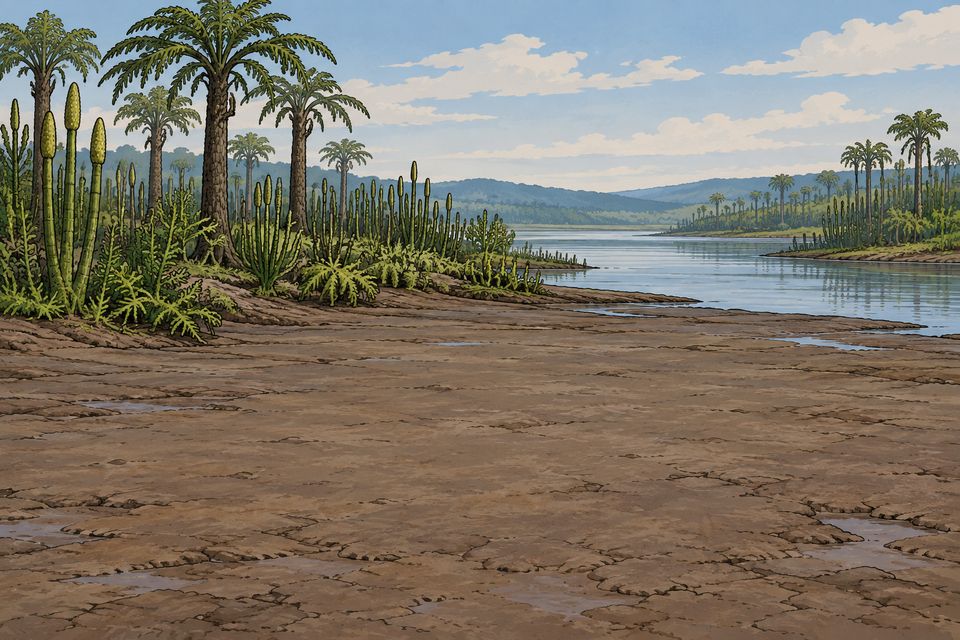
Your home was a network of streams and shallow channels on a tropical floodplain, about 375 million years ago. You were most likely an ambush predator, lying in wait in the shallows and snapping at fish. Being able to prop yourself up and lift your head would help in water too shallow for ordinary swimming. Whether you ever hauled yourself fully onto land is not known.
A predicted fossil
Tiktaalik was found in 2004 on Ellesmere Island in Nunavut, Canada, by a team including Neil Shubin, Edward Daeschler and Farish Jenkins. They chose the site by looking for rocks of the right age and type – river deposits around 375 million years old – where a transitional fish–tetrapod form ought to be. The name, chosen with Inuit elders, means “large freshwater fish” in Inuktitut.
It is not necessarily our direct ancestor, but it shows clearly how fins began turning into limbs.