Dunkleosteus
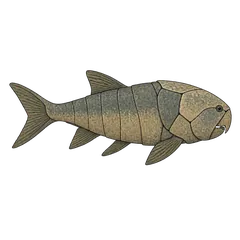
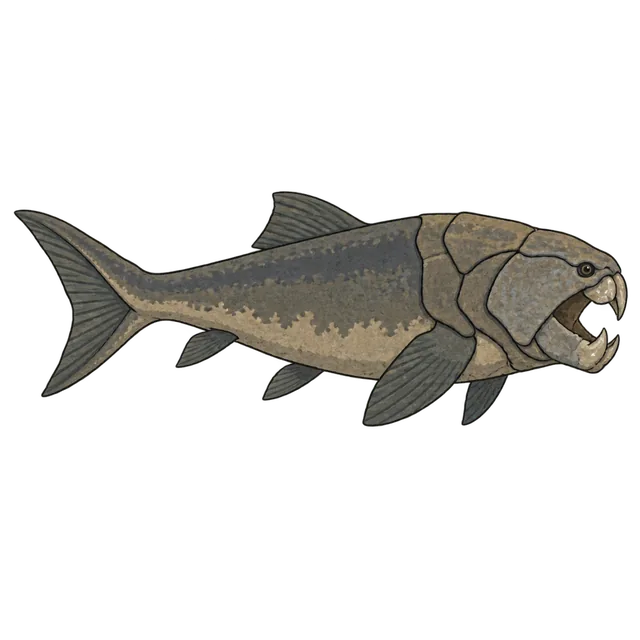
As Dunkleosteus you would patrol Late Devonian seas in a helmet of bone, slicing prey with jaw blades that sharpened themselves every time you bit.
A fish in plate armour
Dunkleosteus was a placoderm, a member of an extinct group of armoured fishes. Your head and the front of your body were enclosed in thick, jointed bony plates; the rest of the body was cartilage and flesh, which rarely fossilised. That is why size estimates vary. Older figures of 6–10 m have been revised by recent studies to a more compact animal of roughly 3.4 m and around a tonne.
You had no true teeth. Instead, the edges of your jaw bones formed sharp shearing blades that wore against each other as you bit, keeping them keen.
The bite
A joint between head armour and body armour let you swing your skull upward while the lower jaw dropped, opening your mouth very fast. Biomechanical modelling suggests this created suction that pulled prey in, followed by a powerful bite capable of cutting through other armoured fish. Fossil regurgitated masses of bone found with Dunkleosteus remains suggest it sometimes threw up indigestible pieces.
Its own kind may have been a danger too: some specimens bear wounds that match Dunkleosteus bites.
Where to find you
You lived about 382–358 million years ago, during the Late Devonian. The best fossils come from the Cleveland Shale of Ohio, deposited in a warm, shallow sea that covered much of North America; other remains are known from Morocco and elsewhere. Placoderms vanished at the end of the Devonian, and Dunkleosteus went with them.
Life would not be all bites and blades. Like other large fish, you would grow slowly from small juveniles, which lived in shallower waters and faced many more predators than the adults did.