Hallucigenia
As Hallucigenia you would be a tiny, tube-shaped animal teetering on clawed legs, with a row of spikes on your back – and scientists would spend decades unsure which end of you was which.
A worm with legs and spikes
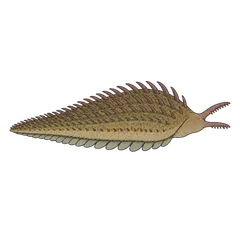
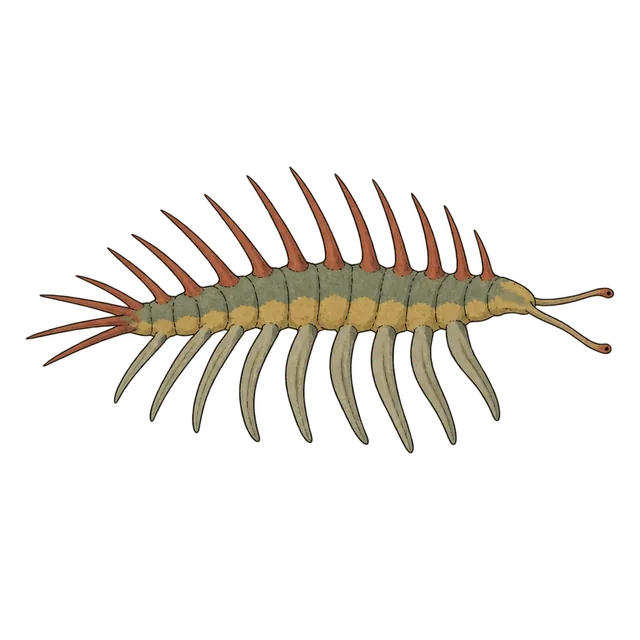
Hallucigenia was a lobopodian, a soft-bodied worm with stubby legs. Most specimens are only 1 to 3 cm long. You would have about seven or eight pairs of slender legs ending in small claws, and seven pairs of stiff spines rising from your back. A few extra tentacle-like limbs near the front may have helped gather food.
Your head was small, with a pair of simple eyes and a mouth ringed by teeth, leading into a throat also lined with tiny tooth-like structures. The spines most likely protected you from being eaten in a sea already full of predators.
Clinging to sponges
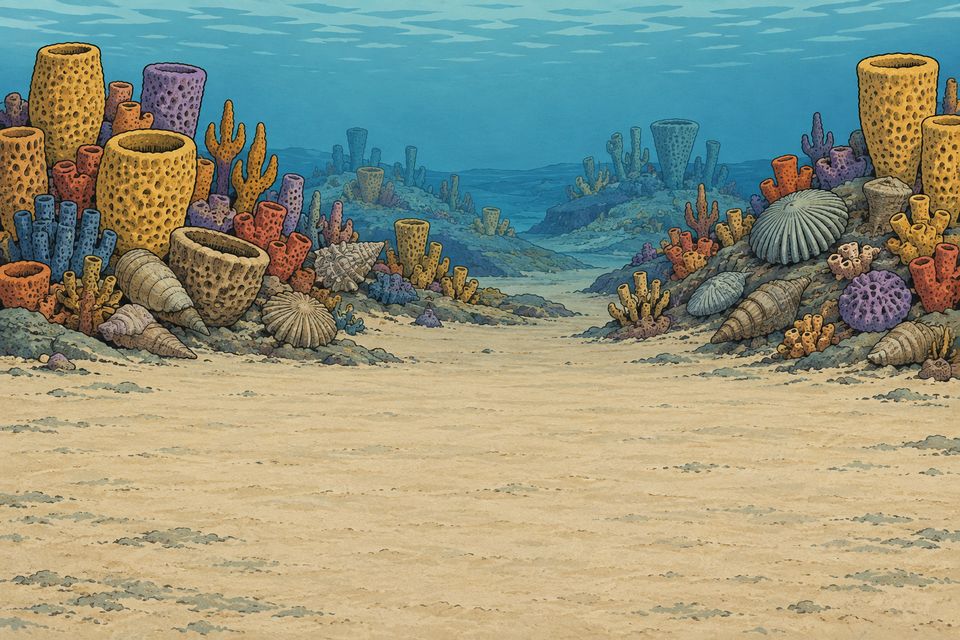
Hallucigenia fossils are sometimes found near sponges, and some researchers think the animals clung to them with their claws, picking food particles from the water or grazing on organic material. Life would be slow and close to the seafloor, waiting out danger behind a fence of spikes.
With only a tiny mouth and legs suited to gripping rather than walking far, you would not go anywhere quickly.
Upside down, then back to front
In 1977 Simon Conway Morris reconstructed Hallucigenia walking on its spines, with a single row of wobbly “tentacles” on its back – so strange that its name refers to hallucinations. In 1991 better fossils from Chengjiang in China showed the spines were on the back and the tentacles were paired legs. Then in 2015 a study using electron microscopy finally identified the head, with eyes and teeth, at the end previously taken for the tail.
Hallucigenia is now seen as an early member of the group that includes velvet worms, which still live in tropical forests today.