Stethacanthus
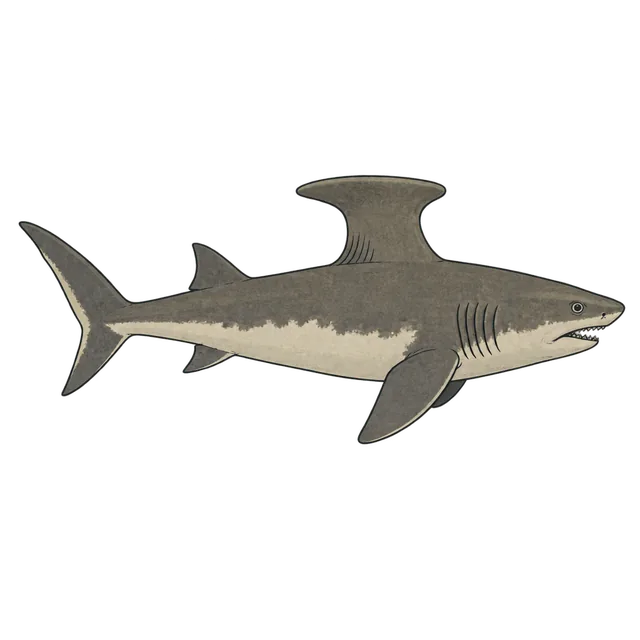
Reborn as Stethacanthus, you would be a modest-sized shark with something absurd on your back: a fin shaped like an anvil, topped with a brush of tiny teeth.
The ironing-board fin
Stethacanthus was an early cartilaginous fish related to sharks, typically up to about 2 m long and often smaller. Its most famous feature was the first dorsal fin, which in mature males formed a tall structure with a flat, brush-like top. Both the top of this fin and a patch on the head were covered with small, tooth-like scales called denticles.
Because this crest appears only in adult males, most researchers interpret it as a display or mating signal, a bit like antlers in deer. Older ideas that it mimicked a large mouth to scare predators, or served as an attachment surface, are now considered less likely.
A shark’s ordinary day
Apart from the crest, life would be fairly shark-like. You would swim in shallow seas hunting small fish, cephalopods and crustaceans, with teeth of a simple, multi-cusped design that were replaced throughout life. Your skeleton was cartilage, so complete fossils are rare; most of what we know comes from exceptional finds in the United States and Scotland, where a closely related shark, Akmonistion, was once placed in the same genus.
As a young male, you would not yet have the crest; it developed as you matured, which supports the idea that it was a sign of adulthood. Your own predators would include larger sharks and armoured fish that survived into the early Carboniferous.
When and where
Stethacanthus lived from the Late Devonian into the Carboniferous, roughly 370 to 345 million years ago or later, in seas covering what is now North America and Europe. It belonged to the symmoriiform sharks, a group that diversified after the end-Devonian extinction wiped out many armoured fishes and opened up new opportunities for sharks.