Volvox
As Volvox you would be one of thousands of tiny green cells set into the surface of a hollow ball, all beating your flagella together so the whole sphere rolls through the water.
A ball that rolls
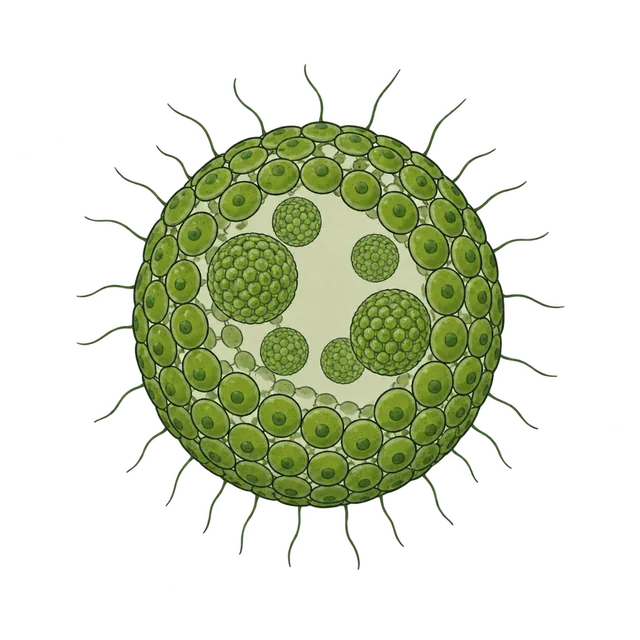
Volvox is a green alga that lives as a spherical colony up to about 1 millimetre across, big enough to see as a green dot in a jar of pond water. Each colony holds roughly 500 to 50,000 small cells, depending on the species, embedded in a jelly-like sphere and often linked by fine cytoplasmic strands. Every cell has two flagella and an eyespot, and their coordinated beating makes the colony spin and roll towards light – hence the name, from Latin volvere, to roll.
Antonie van Leeuwenhoek described these rolling spheres in 1700, and Carl Linnaeus gave the genus its name in 1758.
A division of labour
What makes Volvox special is that its cells are not all equal. Most are small somatic cells that swim and photosynthesise but cannot reproduce. A few – often around 16 in Volvox carteri – are large reproductive cells called gonidia. These divide to form new miniature colonies inside the parent, which you can see as darker green balls within the sphere. Biologists study Volvox as a model of how multicellularity and the split between body and germ cells evolved.
How it ends
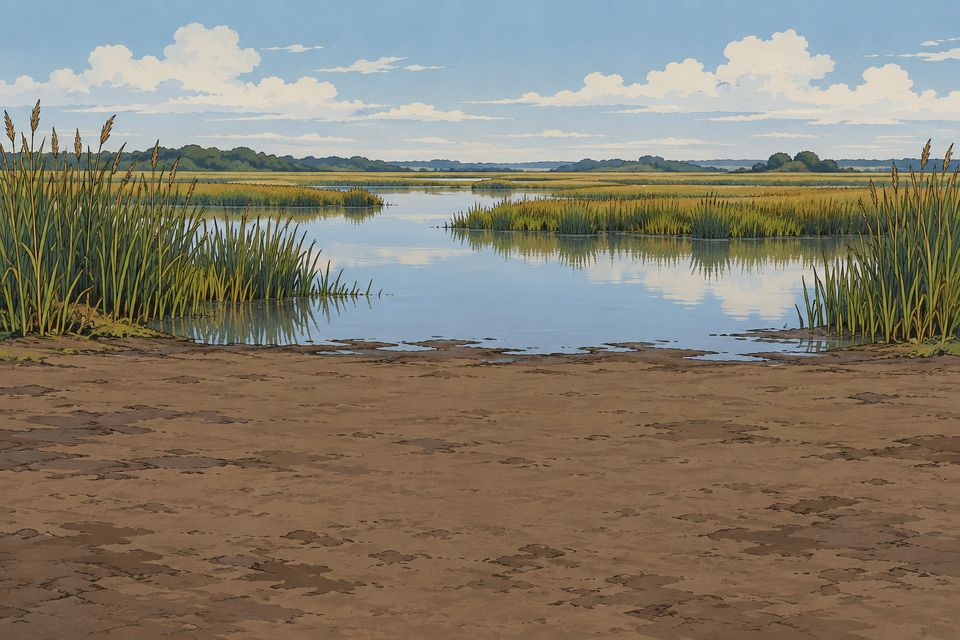
For a somatic cell, life is short and has a clear end. When the daughter colonies are ready, they break free from the parent, which is left behind and dies, typically within a few days. In other words, Volvox shows something like programmed death of the body. When ponds dry or cool down, colonies switch to sexual reproduction and produce thick-walled zygotes that can survive drought until conditions improve.