Plasmodium
As a Plasmodium parasite you would need two hosts to complete your life – a female Anopheles mosquito and a vertebrate such as a human – and you would spend much of the trip hiding inside cells.
A two-host life cycle
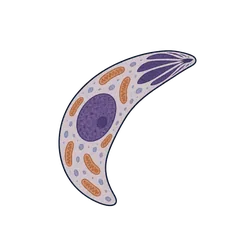
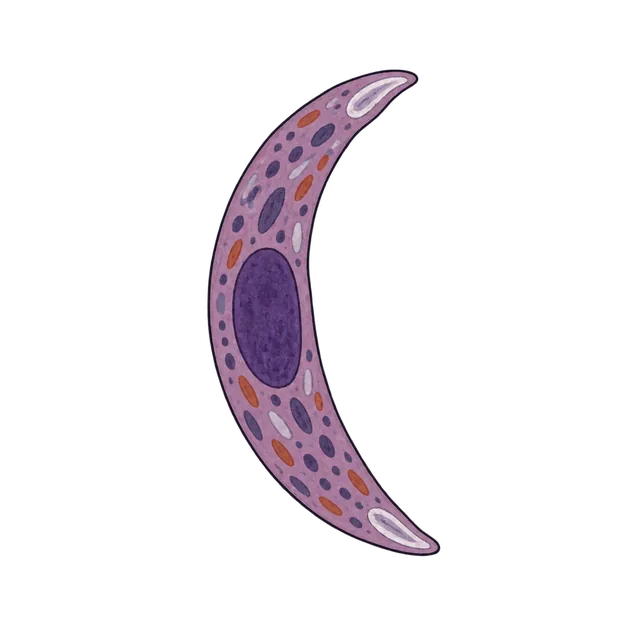
Plasmodium is a single-celled parasite related to Toxoplasma. Five species regularly cause malaria in humans; P. falciparum is the most dangerous and P. vivax the most widespread outside Africa. The cycle begins when an infected female Anopheles mosquito bites and injects a few dozen thread-like sporozoites. Within an hour they reach the liver, where each invades a cell and multiplies over roughly one to two weeks into tens of thousands of new parasites, without causing symptoms.
These then burst into the bloodstream and invade red blood cells, multiplying and bursting out again every 48 hours (72 for P. malariae). The synchronised bursts cause the fever and chills typical of malaria. Some parasites become sexual forms that a feeding mosquito picks up, and the cycle continues in its gut.
Discovery and disease
Alphonse Laveran saw the parasite in a patient’s blood in Algeria in 1880, and Ronald Ross showed in 1897 that mosquitoes transmit it; both received Nobel Prizes. Malaria remains a major disease, with the World Health Organization estimating over 200 million cases and around 600,000 deaths a year, most of them young children in sub-Saharan Africa. It is preventable and curable: prompt diagnosis and treatment, usually with artemisinin-based combination therapies, are highly effective.
The fight against you
Your enemies are many: insecticide-treated bed nets, indoor spraying, preventive medicines for travellers and pregnant women, and since 2021 the first malaria vaccines, RTS,S and later R21, recommended for children in endemic areas. Many countries have eliminated malaria entirely, including several in Europe during the 20th century. For an individual parasite, life usually ends when an immune cell destroys an infected red blood cell, when a drug clears the blood or when a mosquito never comes.