Baker’s yeast
As baker’s yeast you would be a single fungal cell with one overriding talent: turning sugar into alcohol and carbon dioxide – which is why people have kept your ancestors in their kitchens and breweries for thousands of years.
A fungus that buds
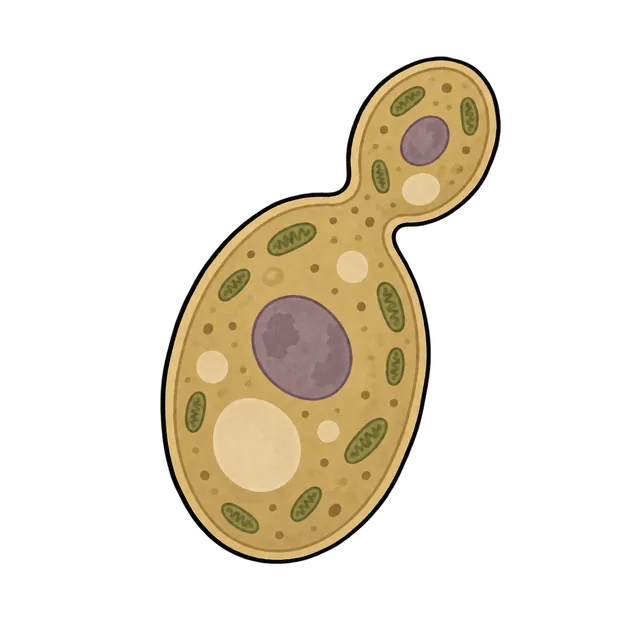
Saccharomyces cerevisiae – ‘sugar fungus of beer’ – is an oval cell about 5–10 micrometres long. It reproduces mainly by budding: a small bulge forms on the mother cell, receives a copy of the nucleus and pinches off as a daughter. Each budding leaves a scar on the mother’s wall, and a typical cell manages around 20–30 buds before it stops dividing, which makes yeast a classic model for studying ageing.
In nature you would live on ripe fruit, tree sap and in insect guts; wasps and other insects that feed on grapes help carry yeast from one season to the next.
Bread, beer and wine
Even with oxygen around, yeast prefers to ferment sugar rapidly into ethanol and CO2 when sugar is plentiful, poisoning slower competitors with alcohol. Humans exploited this long before they knew yeast existed: chemical traces of fermented drinks date back about 9,000 years in China, and bread and beer were staples of ancient Egypt. In bread the CO2 makes the dough rise and the alcohol bakes away; in beer and wine both are kept. Louis Pasteur showed in the 1850s–1860s that fermentation is the work of living yeast cells.
Biology’s favourite cell
In 1996 S. cerevisiae became the first eukaryote – the group that includes plants and animals – to have its whole genome sequenced: about 12 million base pairs and roughly 6,000 genes. Many of these genes have human counterparts, and research on yeast contributed to several Nobel Prizes, including work on the cell cycle (2001) and autophagy (2016). Engineered yeast now produces medicines such as hepatitis B vaccine components. Your own end would come either in a hot oven, in a fermenting tank as alcohol rises beyond what you can tolerate, or after your last bud.