Pennate diatom
As a pennate diatom you would spend your life inside a two-part box made of glass, gliding slowly across riverbed stones and turning sunlight into sugar.

A house of glass
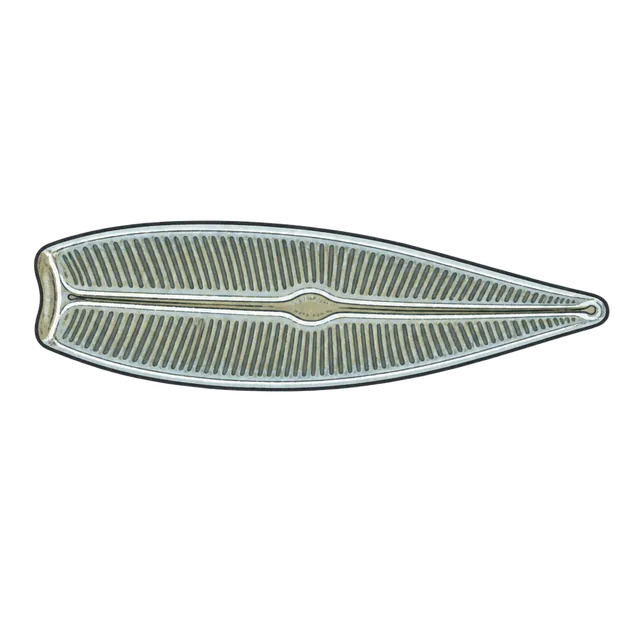
Diatoms are single-celled algae whose cell wall, the frustule, is made of silica – essentially glass. It comes in two halves that fit together like the lid and base of a petri dish, decorated with intricate patterns of pores and ribs that differ from species to species. Pennate diatoms are the elongated, boat- or needle-shaped kind, mostly 10–200 micrometres long, living on mud, rocks, plants and sea ice; their round cousins, the centric diatoms, float in open water.
Many pennate species can glide. A slit along the shell, the raphe, secretes mucilage that the cell pushes against, letting you creep forward or backward at a few micrometres per second towards better light.
Shrinking with every generation
When a diatom divides, each daughter keeps one half of the parent’s shell and builds a new, slightly smaller half inside it. As a result, the average size of a population shrinks generation after generation. When cells reach a critical minimum, they switch to sexual reproduction and form a special cell, the auxospore, which grows back to full size and builds a fresh frustule. It is one of the odder solutions to keeping a body the right size.
Breathing for the planet
Diatoms are among the most important photosynthesisers on Earth; they are commonly estimated to produce around 20 % of global oxygen and a large share of ocean productivity. When they die, their glass shells sink and accumulate. Over millions of years these deposits form diatomaceous earth, mined for filters, mild abrasives and insect control. Forensic scientists also examine diatoms found in a body to help determine whether someone drowned and where. Your own life would likely end in the mouth of a snail, a copepod or a larval fish – diatoms are the base of many aquatic food webs.