Physarum slime mould
As Physarum polycephalum you would be a single cell the size of a dinner plate – a bright yellow, pulsing web spreading over rotting logs in search of food.

One cell, millions of nuclei
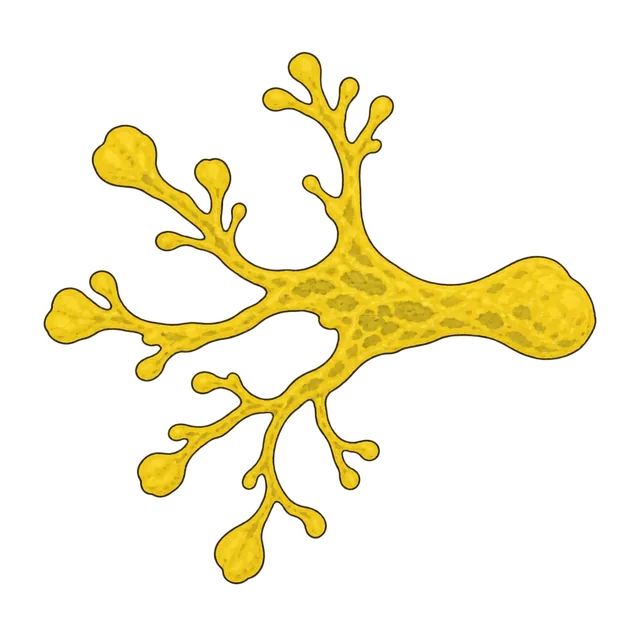
Physarum polycephalum, the ‘many-headed slime mould’, is neither a fungus nor an animal but an amoeba-like protist. In its feeding stage, the plasmodium, it is one enormous cell containing millions of nuclei that divide in sync without the cell itself dividing. It can grow from a speck to tens of centimetres across, or larger in culture, and lives in cool, damp forests on decaying wood and leaf litter.
Your body would be a network of veins through which cytoplasm streams back and forth, reversing direction roughly every minute or two. Where food is found, veins thicken; where it is not, they shrink and are abandoned.
Problem-solving without a brain
You would feed on bacteria, fungal spores and decaying matter, engulfing them as you creep along at up to a few centimetres per hour. That simple growth rule produces surprising behaviour. In 2000 Toshiyuki Nakagaki and colleagues showed Physarum could find the shortest route through a maze between two food sources. In 2010 researchers placed oat flakes in the pattern of cities around Tokyo, and the slime mould built a network strikingly similar to the region’s actual railway system. It also leaves a slime trail it avoids, a kind of external memory.
Drying out and starting over
When food runs out, you have options. You can dry into a hard, dormant mass called a sclerotium, which can revive with water after months or years. Or, given light and starvation, you can turn into dozens of tiny stalked fruiting bodies that release spores. Those spores hatch into separate single cells that pair up and fuse to start a new plasmodium. Physarum also has a remarkable sex life: it has many mating types, so finding a compatible partner is easy.