Thiomargarita
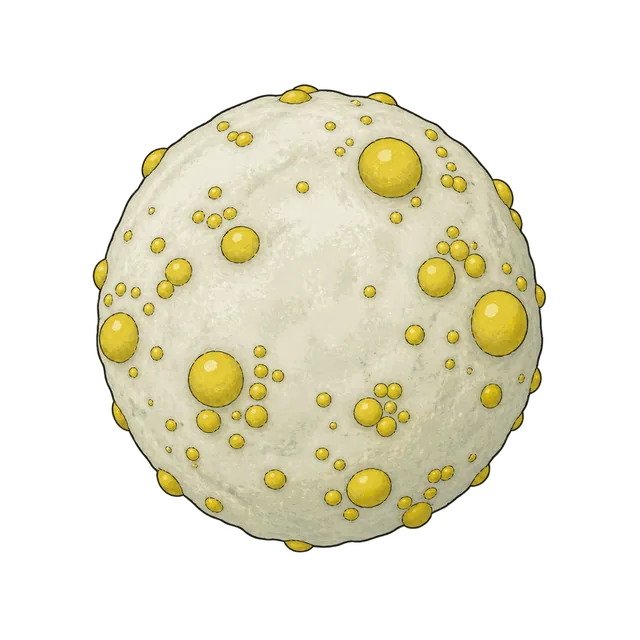
As Thiomargarita you would break the first rule everyone learns about bacteria: that they are too small to see. You would be visible to the naked eye, shining white like a tiny pearl.

A giant among microbes
Thiomargarita namibiensis was described in 1999 from seafloor sediments off the coast of Namibia. Its spherical cells are typically 0.1–0.3 millimetres across, and the largest reach about 0.75 mm – roughly the size of a fruit fly’s head and thousands of times the volume of an E. coli. The name means ‘sulfur pearl of Namibia’, after the glittering granules of sulfur inside each cell, strung together like a necklace in a sheath of mucus.
In 2022 researchers described a relative, Thiomargarita magnifica, from mangrove swamps in Guadeloupe: thread-like cells up to about 2 centimetres long, the largest bacterium known.
Living on a balloon of nitrate
How does a bacterium get so big? Mostly it is hollow. About 98 % of the cell is a central vacuole full of nitrate, with the living cytoplasm forming a thin layer around it. You would make your energy by oxidising hydrogen sulfide from the stinking mud, using oxygen or the stored nitrate. When storms stir the sediment, you would fill up with nitrate from the seawater, then survive for weeks or months on the reserve while lying in the oxygen-free ooze.
A slow, patient life
There is little drama in this existence. You would not swim; you would wait for the sea to come to you. Cells divide slowly, perhaps only every few days or weeks, and much about the species – including how long an individual cell lives – is still unknown because it is hard to grow in the lab. Your chief dangers would be being buried too deep, starving between storms or being grazed by seafloor animals. Your legacy is conceptual: you forced biologists to rethink how large a single bacterial cell can be.