Deinococcus radiodurans
As Deinococcus radiodurans you could take a dose of radiation that would kill a human thousands of times over, shrug, and stitch your shattered chromosomes back together.
Found in a can of meat
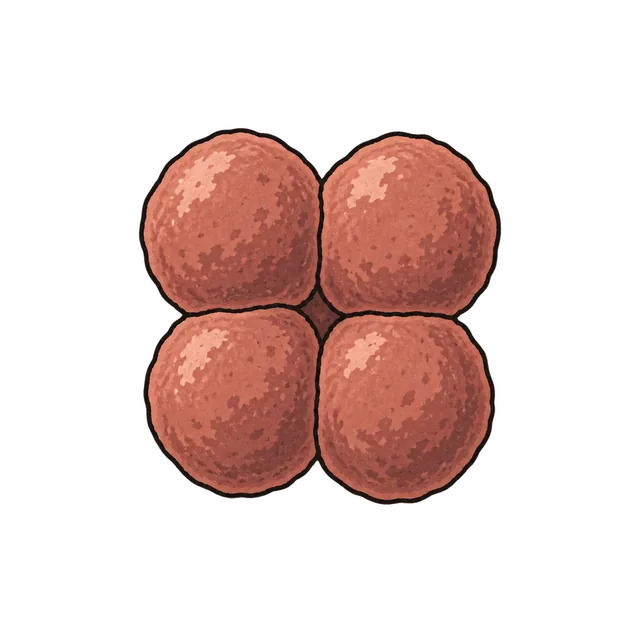
In 1956 scientists in Oregon were testing whether gamma radiation could sterilise canned meat. One can spoiled anyway, and the culprit was a pinkish-red bacterium that had survived the dose. It was named Deinococcus radiodurans – roughly ‘terrible berry that withstands radiation’. Its cells are spheres a couple of micrometres across, usually grouped in pairs or fours, with a thick, layered cell envelope.
Relatives have since turned up in dry soil, desert sand, animal dung, dust and even on surfaces in clean rooms. The Guinness Book of World Records once listed it as the world’s toughest bacterium, and newspapers dubbed it ‘Conan the Bacterium’.
The repair shop
Radiation kills mainly by shattering DNA. Deinococcus can survive about 5,000 grays of gamma radiation without measurable loss of viability, and a fraction of cells survive 15,000 Gy; for comparison, around 5 Gy is often fatal to a person. It is not shielded from the damage – its chromosome is still smashed into hundreds of fragments. The trick is repair: each cell carries several copies of its genome, so it can use one as a template to rebuild another, and it protects its repair proteins from oxidation with manganese-based antioxidants.
Why this skill exists
There is no natural environment on Earth with radiation that intense, so the resistance is probably a side effect of surviving desiccation, which also breaks DNA. Your ordinary life would be spent drying out and rehydrating in soil or dust, waiting for water. Researchers study you for cleaning up radioactive waste, and in the Tanpopo experiment on the International Space Station, dried pellets of Deinococcus survived three years of exposure outside the station – fuel for debates about whether microbes could travel between planets.