Paramecium
As a Paramecium you would be a microscopic slipper covered in thousands of beating hairs, cruising through pond water and steering by bumping into things.

Rowing with thousands of oars
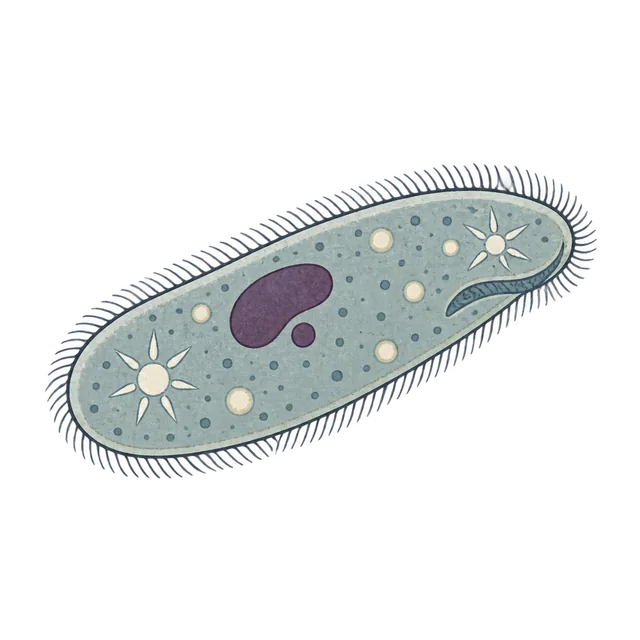
Paramecium is a single-celled ciliate common in ponds, ditches and anywhere decaying plants feed bacteria. Most species are 50–330 micrometres long, shaped like the sole of a shoe – hence the old English name ‘slipper animalcule’. Its surface carries thousands of cilia, tiny hairs that beat in coordinated waves, driving you forward while you rotate along your long axis.
When you bump into an obstacle, your membrane triggers a burst of calcium that reverses the cilia: you back up, turn a little and try again. This ‘avoiding reaction’ uses the same kind of electrical signal that nerve cells use.
Eating and self-defence
A groove along the side, the oral groove, sweeps bacteria and yeast into a cell mouth, where they are packed into food vacuoles and digested as they travel round the cell. Two star-shaped contractile vacuoles pump out excess water. Beneath the surface lie trichocysts, tiny capsules that can shoot out threads, possibly to fend off predators such as the ciliate Didinium – which still often wins and swallows Paramecium whole.
Two nuclei and a clock
Unusually, each cell has two kinds of nucleus: a large macronucleus that runs daily life and a small micronucleus that stores the genome for sexual exchange. You would normally reproduce by splitting across the middle, often once or twice a day. Every so often two cells pair up in conjugation, swap micronuclei and come out genetically refreshed. Some lineages that go too long without this begin to decline, a phenomenon studied as a form of ageing in a single cell. Rather than dying of old age, though, most individuals are simply eaten.