Bdellovibrio
As Bdellovibrio you would be a bacterium that hunts other bacteria – smashing into them at full speed, slipping inside and devouring them from the inside out.
A predator one micrometre long
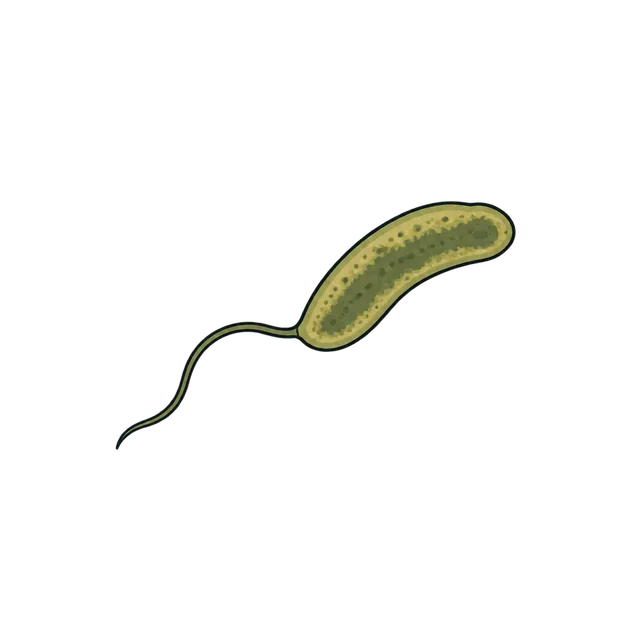
Bdellovibrio bacteriovorus is a small, comma-shaped bacterium, about 0.3–0.5 micrometres wide and around 1 micrometre long – smaller than most of its prey. It was discovered by accident in 1962 by Heinz Stolp and Mortimer Starr, who were looking for bacteriophage viruses in soil and noticed plaques caused by something that moved. The name combines the Greek bdella, a leech, with vibrio, a curved rod.
You would live in soil, rivers, sewage, sediments and even animal guts, wherever Gram-negative bacteria such as E. coli or Pseudomonas are plentiful.
The hunt, step by step
Your life has two phases. In the attack phase you swim with a single sheathed flagellum, reported at around 100 body lengths per second, which makes you one of the fastest swimmers among bacteria. When you hit a suitable prey cell, you attach, drill a hole through its outer membrane and squeeze into the space between its outer and inner membranes, resealing the hole behind you.
Inside, the prey becomes a rounded shell called a bdelloplast. You digest its contents, grow into a long filament and then split into several new attack cells – often between three and six – which burst out to hunt. The whole cycle takes about three to four hours.
Living antibiotic
Because Bdellovibrio preys on many disease-causing Gram-negative bacteria, including antibiotic-resistant strains, it is being studied as a possible ‘living antibiotic’; experiments in animals have shown promise, but it is not an approved treatment. Your own risks are simple: no prey, no food. An attack-phase cell that finds nothing to eat survives only hours to a few days before running out of energy.