Foliose lichen
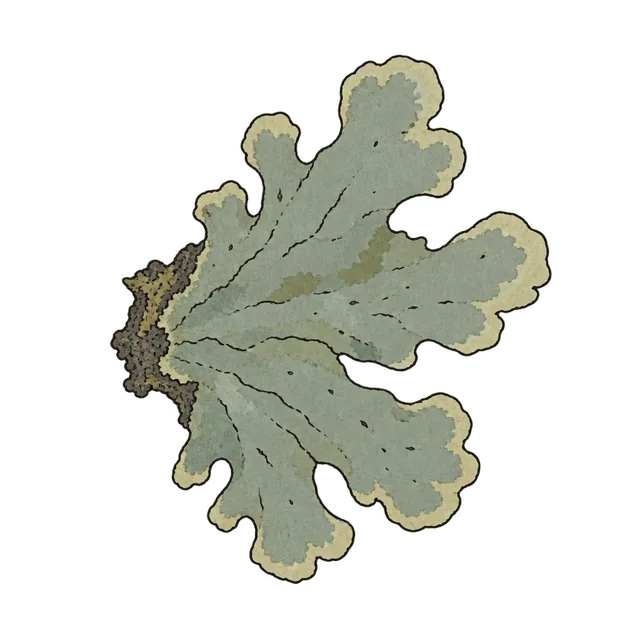
As a foliose lichen you would not be one organism but a partnership – a fungus and a photosynthetic partner living as a single leafy crust on a tree trunk, growing so slowly that a decade barely shows.
Two (or more) in one
A lichen is a symbiosis. The fungus builds the body, anchors it and soaks up water and minerals; inside it live green algae or cyanobacteria that photosynthesise and share sugars. The Swiss botanist Simon Schwendener proposed this dual nature in 1867, to considerable resistance from his colleagues. Research since 2016 has shown that many lichens also contain yeasts in their outer layer, so the partnership can be more crowded than once thought.
Foliose lichens are the leafy kind: flat, lobed sheets loosely attached to bark, rock or walls, like Parmelia and the bright orange Xanthoria parietina often seen on rooftops and branches.
Patience as a lifestyle
You would survive by drying out completely. Lichens have no roots or waxy skin; they lose water within hours in sunshine and can stay dormant and brittle for long periods, then resume photosynthesis within minutes of rain or fog. The cost is speed. Many foliose species grow only a few millimetres a year, and some crustose lichens much less – slowly enough that geologists use lichen size, lichenometry, to estimate how long rock surfaces have been exposed. Individuals can live for centuries.
A living air monitor
Because lichens absorb everything from rain and air, many are very sensitive to pollution, especially sulfur dioxide. In industrial cities of the 19th and 20th centuries, they disappeared from tree trunks, creating ‘lichen deserts’; as air quality improved, many species returned. Scientists still map lichens to assess air quality. Lichens have also fed reindeer through Arctic winters, provided dyes such as litmus and orchil, and been used in perfumery – oakmoss is a lichen. Your end would most likely come from shade, competition, pollution or the tree itself falling.