Tardigrade
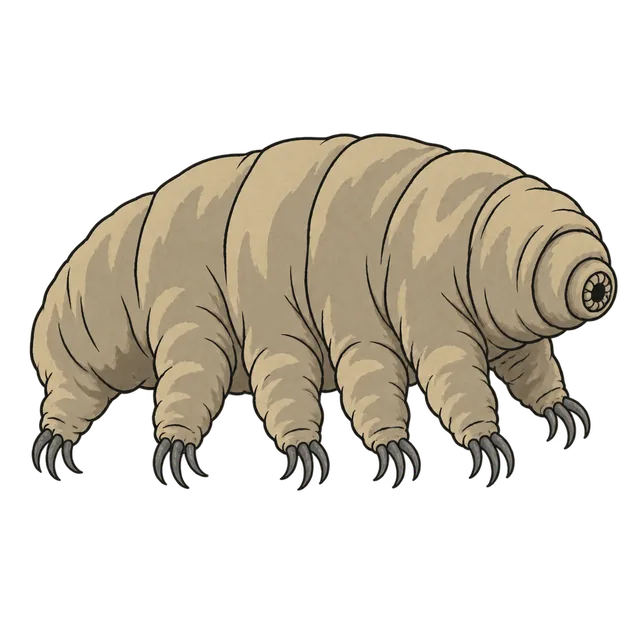
As a tardigrade you would be a plump, eight-legged ‘water bear’ less than a millimetre long, clambering through a film of water on a clump of moss – and capable of shutting your body down almost entirely when things get rough.

A little bear in the moss
Tardigrades are microscopic animals, usually 0.1–0.5 millimetres long, with four pairs of stubby legs ending in claws. The German pastor Johann August Ephraim Goeze called them ‘little water bears’ in 1773, and the Italian Lazzaro Spallanzani gave them the name tardigrada, ‘slow steppers’, in 1777. Over 1,300 species are known, living in oceans, fresh water, soil, and especially in mosses and lichens anywhere from mountaintops to Antarctica.
You would have a mouth with sharp stylets for piercing plant cells, algae or, in some species, smaller animals such as nematodes and rotifers, and you would suck out the contents.
The tun trick
When moss dries out, many tardigrades pull in their legs and head, lose almost all their water and become a shrivelled barrel called a tun. Metabolism falls to almost undetectable levels. In this state, known as cryptobiosis, tun-stage tardigrades have survived temperatures near absolute zero and well over 100 °C for short periods, very high radiation doses, and in 2007 ten days of exposure to open space on the FOTON-M3 mission. Special proteins, including one that shields DNA called Dsup, help protect their cells.
Not quite indestructible
The legends need some trimming. Tardigrades are tough only in the tun state and only for limited periods; active ones are fairly fragile and die easily from warm water or long exposure to heat. Their ordinary lifespan, counting only active time, is typically a few months to a couple of years. Some revived after years of dryness, and in 2016 Japanese researchers revived tardigrades frozen in Antarctic moss for over 30 years. Your daily life would consist of grazing, moulting your cuticle and laying eggs, often inside the shed skin.