Planarian
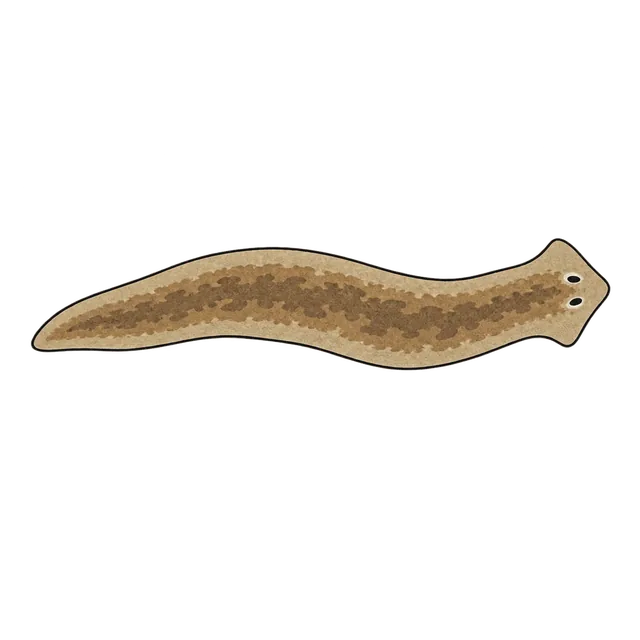
As a planarian you would be a small, flat worm with two eyespots that make you look permanently cross-eyed – and if someone cut you into pieces, each piece could become a new you.

Gliding through the shadows
Planarians are free-living flatworms of fresh water, typically a few millimetres to about 2 centimetres long, found under stones, leaves and logs in streams and ponds. Their simple eyespots detect light but form no images, and planarians avoid it, hiding by day and hunting at night. They glide over a carpet of mucus propelled by cilia on their underside, so smoothly they seem to float, and the ear-like flaps on many species’ heads, the auricles, are packed with chemical sensors.
You would have no lungs or blood vessels; oxygen simply diffuses through your thin, flat body, which is why flatworms cannot grow thick.
Dinner through the belly
Your mouth would sit in the middle of your underside, at the end of a muscular tube, the pharynx, that extends out to suck up food. Planarians eat small worms, crustaceans, insect larvae and dead animals; they find meat quickly by smell, which is why hobbyists catch them with a piece of liver. Food enters a branched gut, and with only one opening, the leftovers leave the way they came in.
The regeneration champion
Planarians owe their fame to regeneration. Species such as Schmidtea mediterranea can regrow a complete animal, brain included, from a fragment as small as about 1/279 of the body, a figure reported by Thomas Hunt Morgan in 1898. The ability comes from neoblasts, adult stem cells spread throughout the body, about 20–30 % of all cells. Some asexual strains reproduce simply by tearing themselves in half. Researchers study them to understand how stem cells rebuild tissues. Death in the wild usually comes from fish, beetles or a stream drying up.