Opabinia
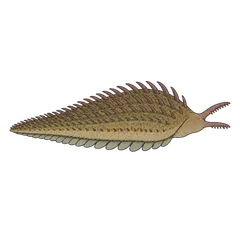
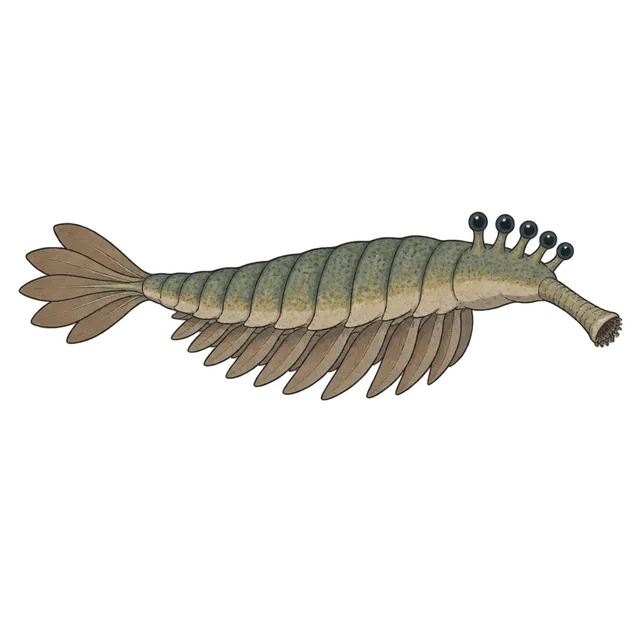
If the wheel makes you Opabinia, you get five eyes, a vacuum-hose snout with a claw on the end, and a body about the length of your current finger.
Five eyes, one nozzle
Opabinia was small – roughly 4 to 7 cm long – but anatomically outrageous. On top of your head sat five eyes on short stalks, giving you a wide view of the seafloor. From the front of your head hung a long, flexible proboscis tipped with a grasping claw lined with spines.
Your body was segmented, with a pair of lateral flaps on each segment and a tail fan of blades at the rear. The flaps probably moved in waves for swimming, and gills sat along the body to extract oxygen from the water.
Feeding like a grabber arm
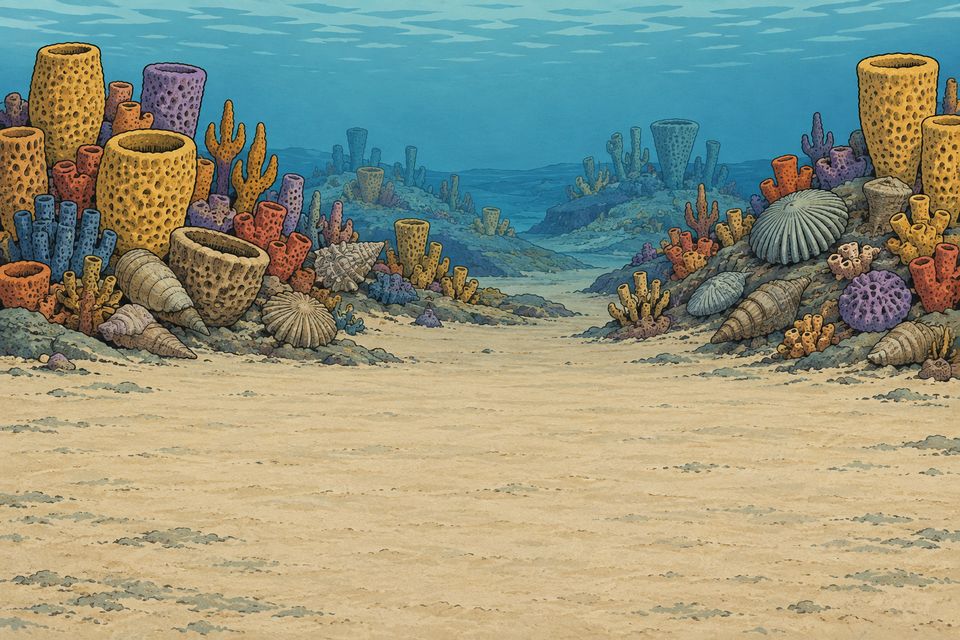
The mouth was on your underside, facing backwards, so the proboscis did the hunting. You would probe the sediment or water, clamp small prey or food particles in the claw, then bend the nozzle back to deliver it to your mouth. Your neighbours in Cambrian seas included trilobites, sponges and the much larger Anomalocaris, one of the predators you needed to avoid.
Only a few dozen good specimens are known, so much of your daily life remains educated guesswork.
The animal that made scientists laugh
Opabinia was first described by Charles Walcott in 1912 from the Burgess Shale of British Columbia, about 508 million years old. When palaeontologist Harry Whittington presented his detailed reconstruction at a scientific meeting in the 1970s, the audience reportedly laughed – the animal looked like a joke.
Today Opabinia is taken very seriously. It is seen as a close relative of the arthropod lineage, sitting near the radiodonts on the evolutionary tree, and it helps show how the arthropod body plan was assembled step by step.