Megatherium (giant ground sloth)
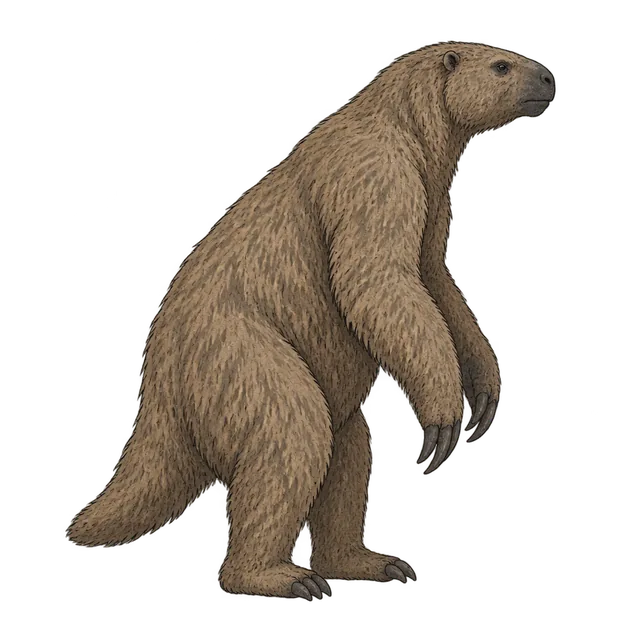
Reborn as Megatherium, you would be a sloth the weight of an elephant, rearing up on your hind legs to pull down branches with enormous curved claws.
A sloth on a grand scale
Megatherium americanum was one of the largest land mammals of its time in South America. Estimates suggest a length of around 6 m and a weight of about 4 tonnes. Unlike modern tree sloths, you would live on the ground. Your hind legs and thick tail formed a tripod, letting you stand upright to reach tall vegetation. Your forelimbs carried huge claws, and because they curved inward, you probably walked on the sides of your feet and on your knuckles.
A diet of leaves
Your teeth and jaws were adapted to slicing leaves and shoots, and most researchers see Megatherium as a browser that fed on trees and shrubs. Some have argued that its strong forelimbs could have been used to scavenge carcasses or fend off predators, though plant-eating is the better-supported view. Few predators would dare tackle a full-grown adult; young sloths were more vulnerable.
Its large size meant a slow metabolism and a need to eat large amounts of vegetation. Young sloths may have stayed with their mothers for a long time, as modern sloths do.
Darwin, Cuvier and the end
Megatherium has an important place in the history of science. A skeleton found in Argentina was sent to Madrid in 1789, and Georges Cuvier described it in 1796, using it as evidence that species could become extinct. Charles Darwin later collected ground sloth fossils in Argentina during the Beagle voyage.
Megatherium disappeared around 12,000 years ago, shortly after humans arrived in South America. Cut-marked bones at some sites suggest people hunted or butchered giant sloths, and climate change likely also played a role.