Elasmotherium
As Elasmotherium you would be a rhino the size of a mammoth calf, grazing the steppes of Eurasia with a massive bony dome on your forehead that probably carried a single great horn.

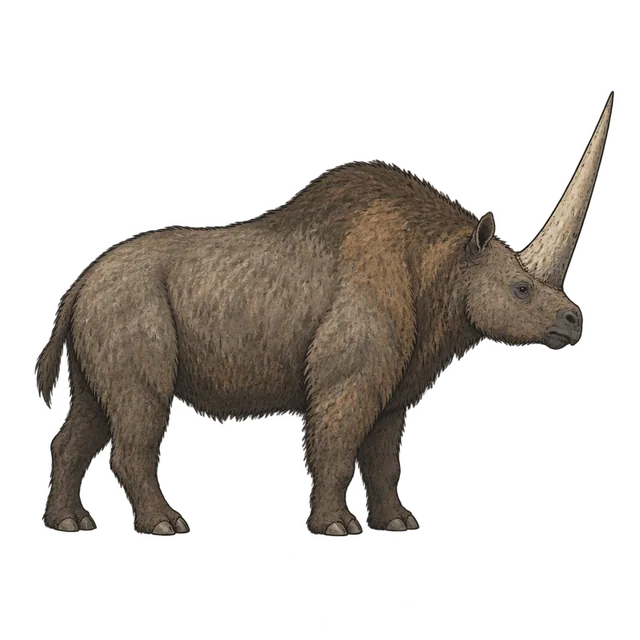
The “Siberian unicorn”
Elasmotherium sibiricum was a giant rhinoceros, around 4.5 m long and estimated at about 3.5–4.5 tonnes. Its most famous feature is a huge bony boss on the forehead, which is usually interpreted as the base of a single large horn made of keratin. The horn itself has never been found, so its exact size and shape are unknown, though reconstructions often show it at a metre or more.
Elasmotherium was only distantly related to woolly rhinos and living rhinos; its lineage separated from theirs tens of millions of years ago.
Grazing the dry steppe
Your teeth were tall-crowned, with folded enamel and no roots in the usual sense – they kept growing, adapted to grinding gritty, dry grasses. You would graze on the open steppes of what is now Kazakhstan, southern Russia and neighbouring regions, with your head held low. Your size would deter most predators, though cave lions, hyenas and humans may have taken young individuals.
With a low-slung head and long legs, you could probably move at a decent pace when needed, though you were not built for sprinting. The horn may have been used for display, defence or digging for roots and water, though none of these uses can be confirmed.
Later survival than expected
For a long time, Elasmotherium was thought to have died out around 200,000 years ago. A 2018 study using radiocarbon dating showed that the species survived until at least 39,000 years ago, overlapping with modern humans in Eurasia. Its decline is linked to climate change, which affected the dry steppe grasslands it depended on, rather than to human hunting.