Homotherium
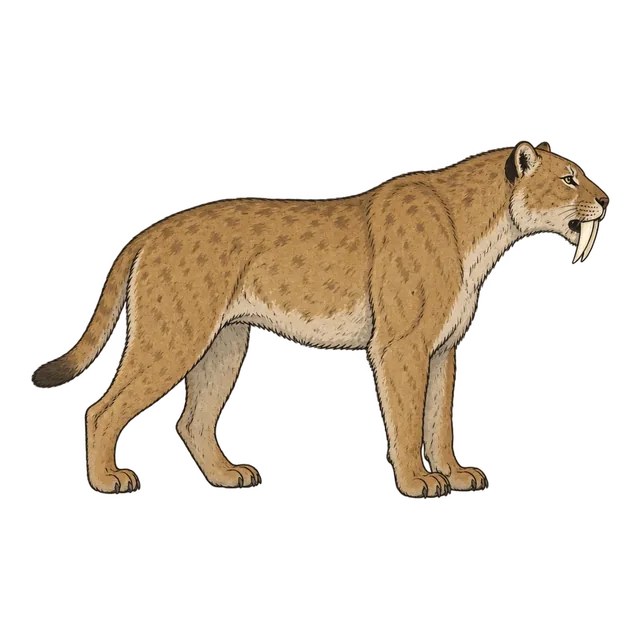
Reborn as Homotherium, you would be a long-legged, sloping-backed cat with serrated scimitar teeth, built more for long chases across open steppe than for ambush.

Scimitars, not daggers
Homotherium was a machairodont, a relative of Smilodon, but with a different design. Your upper canines were shorter, flatter and serrated, like scimitars. Your forelimbs were longer than your hind limbs, giving you a sloping back somewhat like a hyena’s, and you weighed roughly 150–200 kg or more. Some adaptations of the skeleton suggest you could keep up a steady pace over long distances.
Your nostrils were large and your nasal passages wide, which some researchers link to endurance running in cold air. Your incisors were large and arranged in an arc, useful for gripping and pulling prey, and your bite was less specialised than Smilodon’s.
What you hunted
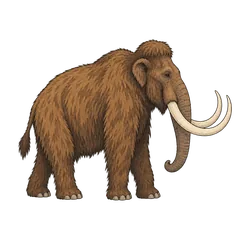
A cave in Texas, Friesenhahn Cave, contained Homotherium remains along with the bones of hundreds of young mammoths, suggesting these cats specialised in hunting mammoth calves and dragging them back to their den. You may have lived and hunted in groups.
A frozen Homotherium cub, about 35,000 years old, was found in Yakutia, Siberia, and described in 2024. It showed a dark coat, a thick neck, small ears and broad paws suited to snow – the first time scientists could see what this cat looked like in the flesh.
Wide range, late survival
Homotherium lived across Africa, Europe, Asia and the Americas for millions of years. In Europe it was long thought to have died out about 300,000 years ago, but a jawbone dredged from the North Sea was dated to around 28,000 years old. In North America it survived until the end of the last ice age.