Edaphosaurus
Reborn as Edaphosaurus, you would carry a sail much like Dimetrodon’s – but you would spend your days munching plants and hoping Dimetrodon did not notice you.
A sail with crossbars
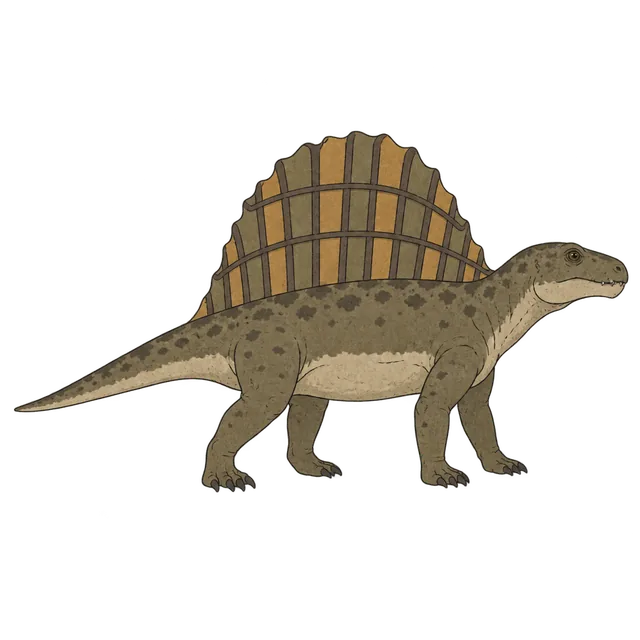
Edaphosaurus was a synapsid, like Dimetrodon, and lived about 303–280 million years ago, from the late Carboniferous into the early Permian. Large individuals reached around 3 m in length. Your back sail was supported by tall spines studded with small sideways knobs or crossbars, which made it look rather like a ship’s rigging. What these crossbars were for remains unknown; display is a common suggestion.
An early vegetarian
You were one of the first large plant-eating land vertebrates. Your head was small for your body, and you had peg-like teeth along the jaws plus batteries of crushing tooth plates on the palate and lower jaw, used to grind tough vegetation. Your barrel-shaped body probably housed a long gut for digesting plant material – a body plan later repeated by many herbivores.
Plant-eating on land was a relatively new lifestyle at the time, and Edaphosaurus is one of the animals that shows it taking off. Grinding food took time, so you would spend much of each day feeding. A large gut also produced heat as it fermented plant matter, which may have helped keep your body warm. Some researchers think Edaphosaurus may have eaten molluscs as well as plants, though this is not widely accepted.
Neighbours and dangers
You lived in North America and Europe, and you shared the landscape with predatory synapsids such as Dimetrodon. Some scientists have suggested your sail may have helped you look larger or more intimidating, though this is speculative. In the end, Edaphosaurus and its relatives died out during the early Permian as climates became drier and new kinds of herbivores appeared.