Helicoprion
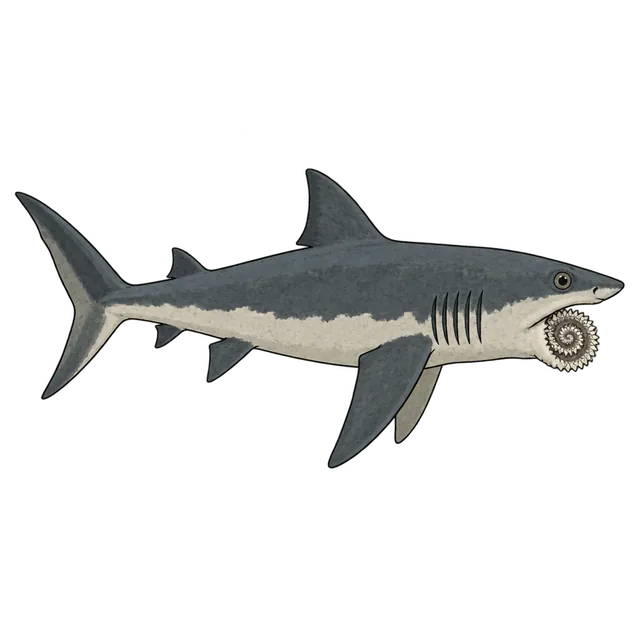
As Helicoprion you would carry a circular saw in your mouth: a spiral of teeth in your lower jaw that kept growing, with the oldest teeth curling away inside it.

The tooth whorl
For more than a century, Helicoprion was known almost entirely from its tooth whorls – flat spirals of serrated teeth up to about 50 cm across. New teeth formed at the outer end, while older, smaller ones were pushed inward and coiled up. Early reconstructions placed the whorl on the snout, in the throat, on the tail or even as a dorsal fin.
In 2013, CT scans of a specimen from Idaho showed the whorl sat inside the lower jaw, filling the middle of it, with the upper jaw largely toothless. The same study confirmed that Helicoprion was not a true shark but a eugeneodont, related to modern ratfish (chimaeras).
How you would feed
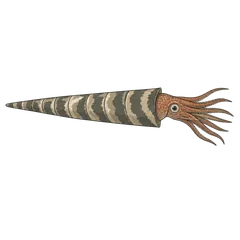
As your jaw closed, the whorl would rotate slightly backwards through the prey, cutting and pulling it into your mouth. This suggests soft-bodied prey such as squid-like cephalopods, which were common in Permian seas. Estimates of body length vary widely; some put large individuals at around 5–8 m, though this remains uncertain because the skeleton was cartilage and is rarely preserved.
You would probably cruise the open ocean rather than reefs, possibly at considerable depth. Without knowing your body shape precisely, scientists usually reconstruct you as a streamlined, shark-like swimmer.
A worldwide fossil
Helicoprion lived about 290–270 million years ago, in the early Permian. Tooth whorls have been found in the United States, Russia, Japan, Australia and elsewhere; many of the best come from the Phosphoria Formation of Idaho. It was first named by the Russian geologist Alexander Karpinsky in 1899. Its name means “spiral saw”.