Medieval archer
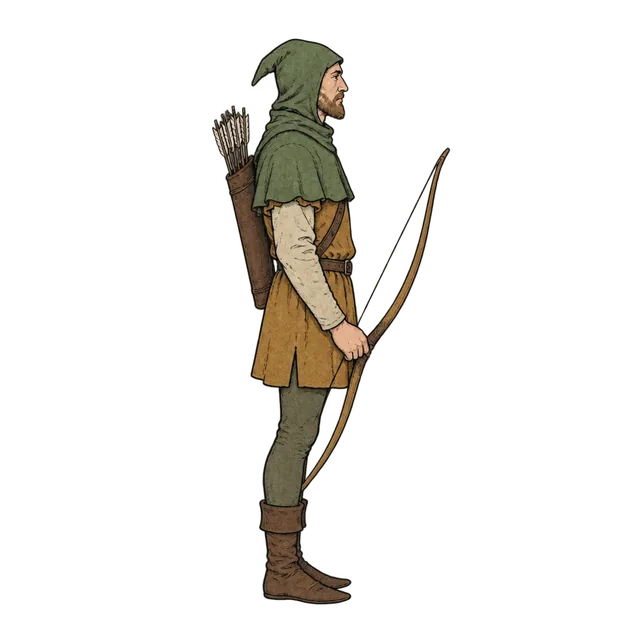
As an archer you would have a bow taller than yourself, a back and shoulders built by years of practice – and a key role in battles that knights preferred to remember as their own.
Built by the bow
The English and Welsh longbow was a single stave of yew, typically around 1.8–2 metres long. Its draw weight – the force needed to pull it back – was high: bows recovered from the warship Mary Rose, sunk in 1545, have been estimated at roughly 45–80 kg of draw, far beyond most modern recreational bows. Drawing such a bow required strength and technique developed from childhood. English laws repeatedly required men to practise archery, and skeletons of archers from the Mary Rose show enlarged left arms and characteristic changes to shoulders and spines.
Arrows in the sky
A skilled archer could loose perhaps 10–12 aimed arrows a minute. Massed in thousands, often behind stakes or on the flanks of dismounted men-at-arms, they could break cavalry charges and disorder enemy formations. The English victories at Crécy in 1346 and Agincourt in 1415, during the Hundred Years’ War, made the longbowman famous. Arrowheads came in different types: broad heads for horses and lightly armoured men, narrow ‘bodkins’ for mail.
Pay, life and limits
Archers were usually commoners, often recruited by contract and paid wages – in the 14th century around 6 pence a day for a mounted archer, more than a labourer earned. Away from battle they marched, foraged, guarded camps and joined raids. Not every army relied on longbows; across Europe, including Poland, bows of various kinds and increasingly crossbows were used. As plate armour improved and handguns spread in the 16th century, the longbow’s importance faded. Steppe peoples such as the Mongols, who invaded Poland in 1241, fought instead with short composite bows from horseback.