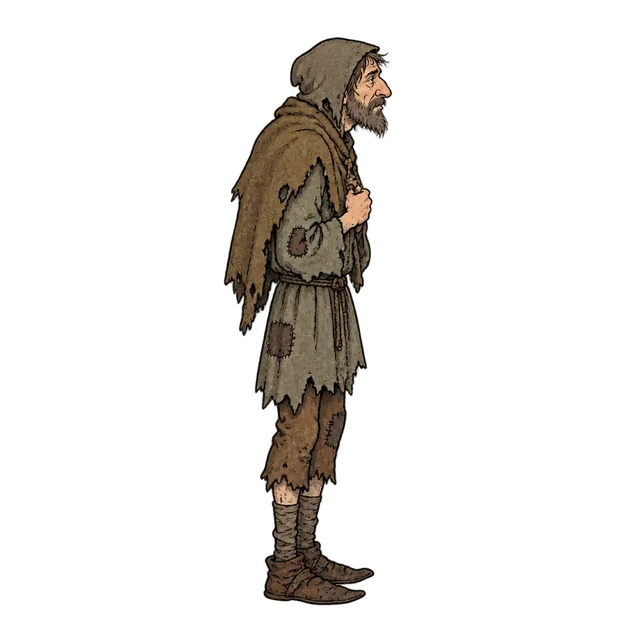
Medieval beggar
As a medieval beggar you would live on other people’s piety – and on how convincingly you could show that your poverty was not your fault.
Who were the poor?
Medieval poverty had many faces. Some beggars were disabled, blind or chronically ill; others were widows, orphans, old labourers who could no longer work, or peasants ruined by a bad harvest, war or fire. Their number swelled in famine years such as the Great Famine of 1315–1317, when wet weather destroyed crops across northern Europe. Without pensions or insurance, losing the ability to work – or losing a family – could tip anyone into begging.
A place in the Christian order
Christian teaching gave the poor a real role. Almsgiving was a work of mercy that helped the giver’s soul, and the poor were expected to pray for their benefactors in return. Beggars gathered at church doors, along pilgrimage routes and at funerals, where wealthy people often left money for doles to the poor. Monasteries handed out bread at the gate, and towns and guilds founded hospitals – which were less medical clinics than refuges providing food, a bed and spiritual care for the sick, the old and travellers.
Voluntary poverty was also prized: the Franciscans and Dominicans, founded in the early 13th century, deliberately lived by begging, and were called mendicant – begging – orders.
From pity to suspicion
Attitudes hardened in the late Middle Ages. After the Black Death, when labour was scarce, authorities began to distinguish the ‘deserving’ poor, who could not work, from able-bodied ‘sturdy beggars’, who supposedly would not. England’s Ordinance of Labourers of 1349 forbade giving alms to able-bodied beggars. Towns introduced begging licences and badges, expelled outsiders and punished vagrants. Life on the street was hard: exposure, hunger and disease shortened lives, and winter was the most dangerous season of all.