Tanystropheus
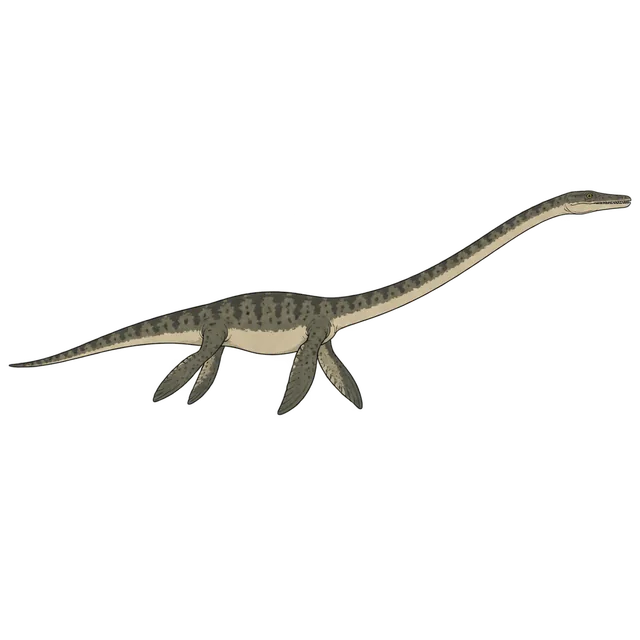
As a Tanystropheus you would carry a neck longer than the rest of your body – stiff as a fishing rod and built from just thirteen enormously stretched vertebrae.
A Middle Triassic oddity
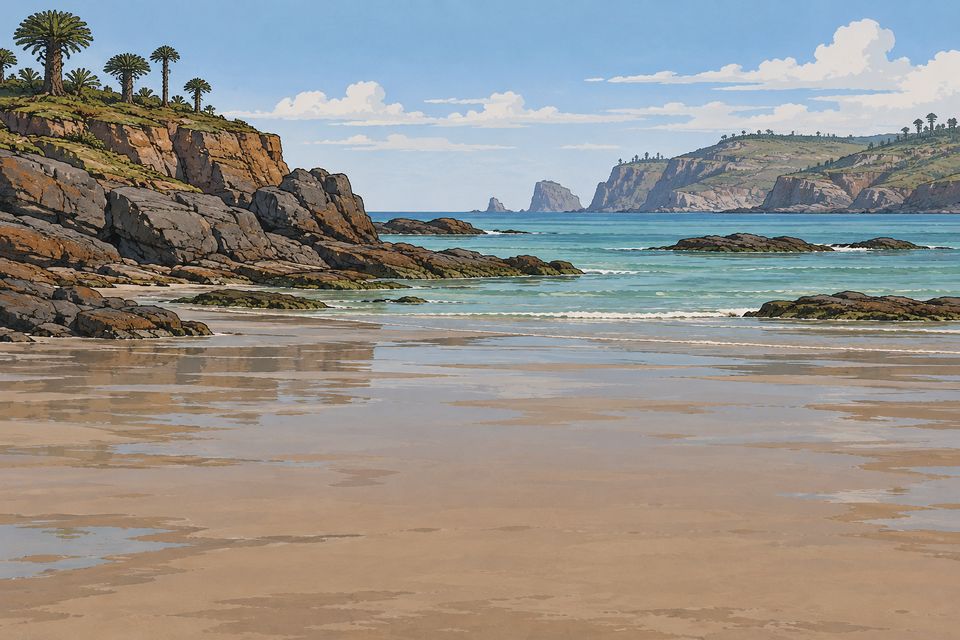
Tanystropheus lived about 242 million years ago, in the Middle Triassic, along the coasts and lagoons of the Tethys Ocean. The finest specimens come from Monte San Giorgio on the Swiss–Italian border, a UNESCO World Heritage Site famous for its marine reptiles. It was an archosauromorph – part of the broad group leading towards crocodiles and dinosaurs – but not a dinosaur itself, and it appeared before the first dinosaurs were common.
The big species reached about 5–6 metres, roughly half of which was neck. Unlike a giraffe, which has seven neck vertebrae, it had thirteen, each extremely long and braced by thin, rod-like ribs. The result was a neck that was long and fairly stiff.
Ambush from the shallows
How could such an animal live? A 2020 study using CT scans of a crushed skull found the nostrils on top of the snout, like a crocodile’s, pointing to a mostly aquatic life. The likely technique: lurk in shallow water and use the long neck to approach fish and squid-like animals without spooking them with the bulk of the body. Hooklets from cephalopod arms have been found in the stomach area of specimens. The same study showed that two forms had been confused: a large fish-eater, T. hydroides, and a smaller species, T. longobardicus, with teeth suited to shrimp-like prey.
The weak spot
A neck like that has a price. In 2023, researchers described two Tanystropheus specimens, one large and one small, whose heads and necks had been bitten clean off, with tooth marks at the break. A predator, probably a large marine reptile, seems to have gone for the neck. If this life ends badly, it is likely to end there.