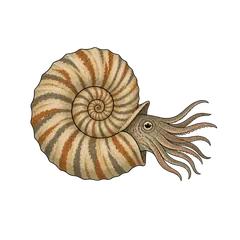
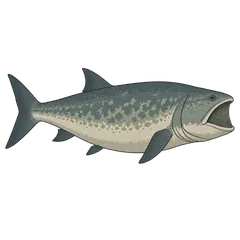
Kaprosuchus
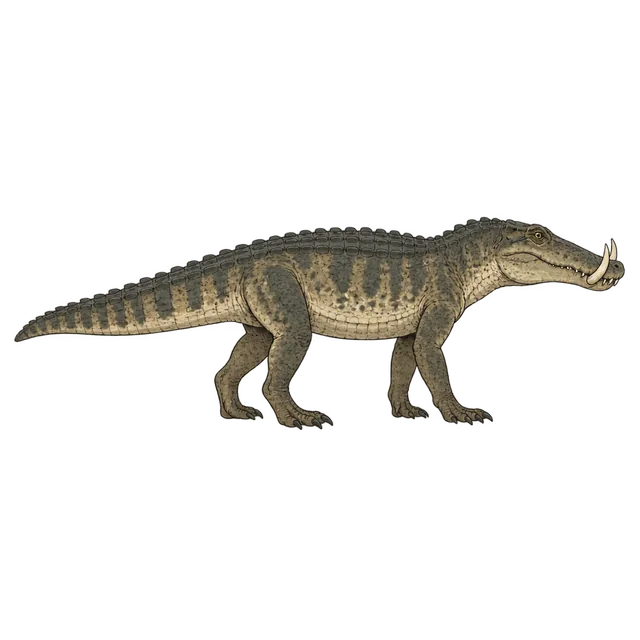
As a Kaprosuchus you would sport not one but three pairs of tusk-like fangs, sticking out above and below your jaws like a wild boar’s.
One skull, a lot of character
Kaprosuchus saharicus is known from a single, nearly complete skull about 50 centimetres long, found in the Echkar Formation of Niger and dating to roughly 95 million years ago, in the early Late Cretaceous. It was described in 2009 by Paul Sereno and Hans Larsson in a study of Saharan crocodyliforms that also gave the world the nicknames ‘PancakeCroc’ (Laganosuchus) and ‘RatCroc’ (Araripesuchus rattoides). The name means ‘boar crocodile’. Its total body length is estimated at around 6 metres.
It belonged to the Mahajangasuchidae, an extinct family of crocodyliforms – relatives of crocodiles, not dinosaurs.
Built for land?
The tusks – enlarged teeth in the upper and lower jaws that projected past the jaw margins – are the obvious feature, but other details are just as telling. The eye sockets point somewhat forward and upward, and the nostrils face forward rather than sitting on top of the snout as in water-dwelling crocodiles. The back of the skull bears bony horn-like extensions, possibly for display or for anchoring jaw muscles, and a rough, armoured snout tip that may have served as a battering ram. Sereno and Larsson suggested it hunted mainly on land, perhaps moving at a gallop. Without a skeleton, its posture remains an inference from the skull.
A crowded neighbourhood
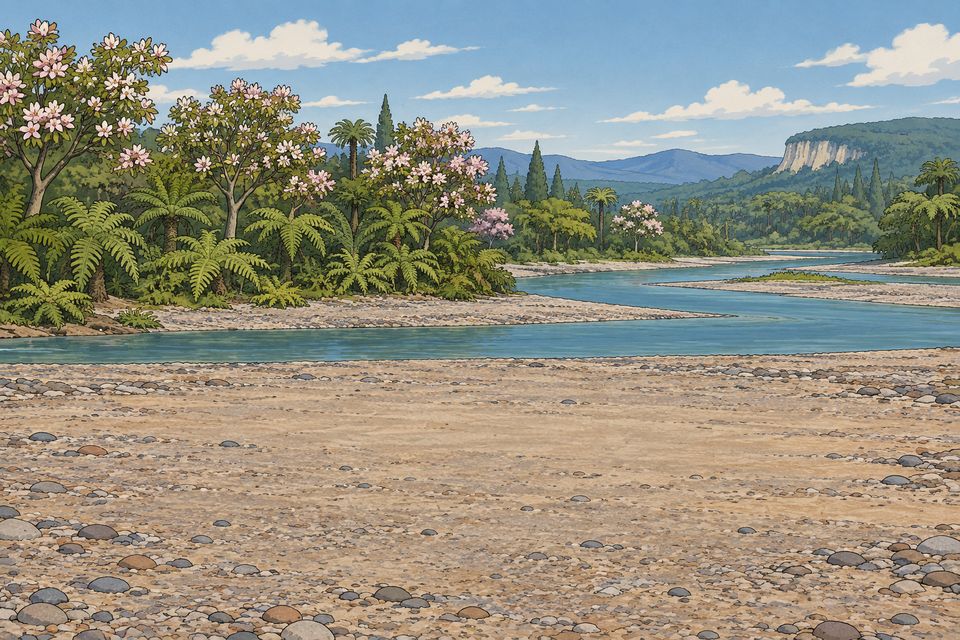
The Echkar Formation preserves rivers and floodplains shared with the abelisaurid theropod Rugops, sauropods and other crocodyliforms. As a Kaprosuchus you would be a mid-to-large predator, probably ambushing dinosaurs and other prey, while staying out of the way of the big theropods. Nothing is known about its eggs, growth or lifespan.