Mosasaurus
Reborn as a Mosasaurus, you would be a lizard the length of a bus – a distant cousin of today’s monitors and snakes – at the very top of the last Cretaceous food chain.
A lizard that went to sea
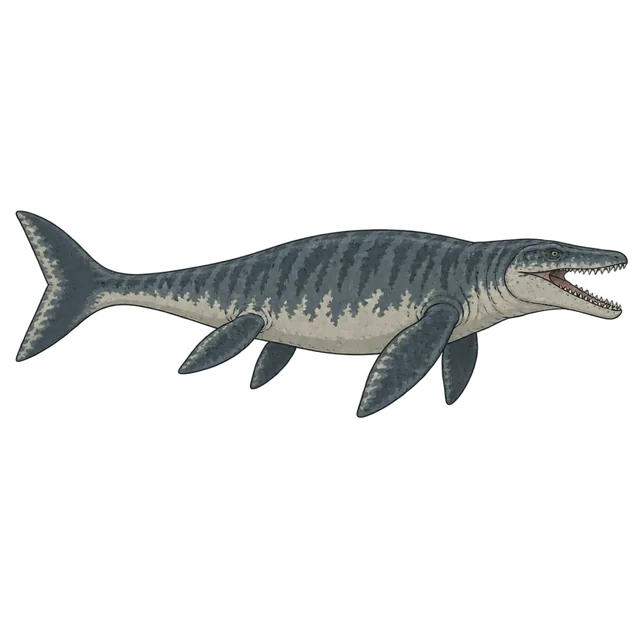
Mosasaurs were not dinosaurs, and not close relatives of ichthyosaurs or plesiosaurs either. They were squamates, the group that includes lizards and snakes, which took to the sea around 98 million years ago and within some 30 million years spread across the globe. Mosasaurus itself, living from about 82 to 66 million years ago, was among the last and largest. The best-known species, M. hoffmannii, is estimated at around 12 metres long or a little more.
The body looked built for open-water cruising: paddle-shaped limbs for steering, a long, deep tail and, as exceptional fossils of related mosasaurs show, a downturned tail fin rather like a shark’s.
Teeth everywhere
Your jaws would carry big, cutting cone-shaped teeth, and the roof of your mouth a second set on the pterygoid bones, which helped ratchet prey down the throat, as in snakes. A flexible joint in the lower jaw let it open wide. On the menu: fish, sea turtles, seabirds, other marine reptiles including smaller mosasaurs, and probably ammonites – some ammonite shells bear rows of punctures interpreted as mosasaur bites, although not every such case is accepted. Like ichthyosaurs, mosasaurs gave birth to live young at sea.
A skull taken as war booty
The genus is named after the river Meuse (Latin Mosa). Around 1780, quarrymen in the chalk tunnels of St Pietersberg near Maastricht dug out a huge jaw. When French revolutionary troops took the city in 1794, the skull was carried off to Paris, reportedly in exchange for a reward of wine, and it is still at the National Museum of Natural History there. Studying it, Georges Cuvier argued that some species had become extinct – a radical idea at the time.
The ending for this lineage was abrupt: mosasaurs died out with the asteroid impact 66 million years ago.