Plague rat
As a black rat in 1348 you would be quick, clever and an excellent climber – and, very possibly, carrying fleas loaded with one of history’s deadliest bacteria.

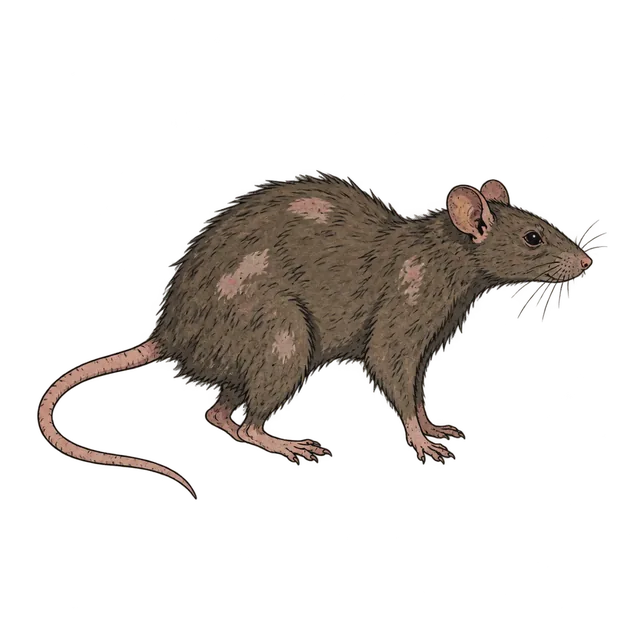
The black rat
The rat of medieval Europe was mostly the black or ship rat, Rattus rattus, not the larger brown rat that dominates cities today and spread across Europe only from around the 18th century. Black rats have a body of roughly 16–24 cm and a tail longer than that, and they are agile climbers that like roofs, thatch, granaries and ships. They breed fast: a female can have several litters a year. In the wild most live only about a year. They eat almost anything – grain, fruit, kitchen scraps, insects – and rely more on smell and sensitive whiskers than on eyesight.
Fleas, bacteria and the Black Death
Plague is caused by the bacterium Yersinia pestis. Among rodents it spreads through fleas, especially the oriental rat flea. When infected rats die, hungry fleas leave the cooling bodies and may bite humans instead. Rats are victims too: plague kills them in large numbers.
The Black Death reached Europe in 1347 and swept through it by 1351–1353, killing an estimated 30–60% of the population. Ancient DNA from victims’ teeth has confirmed beyond doubt that Y. pestis was the culprit.
Guilty or framed?
How much rats were to blame is debated. The speed of spread in some places, and the lack of written reports of mass rat die-offs, has led some researchers to argue that human fleas and body lice, moving directly between people, drove many outbreaks. Others maintain that rats and their fleas were central. Most likely several routes mattered, including the pneumonic form passed by coughing. Either way, as a rat you would be both a carrier and a casualty – and an unfair symbol of the catastrophe for centuries after.