Leedsichthys
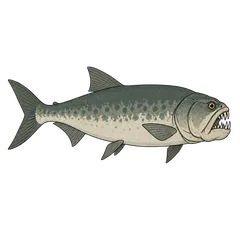
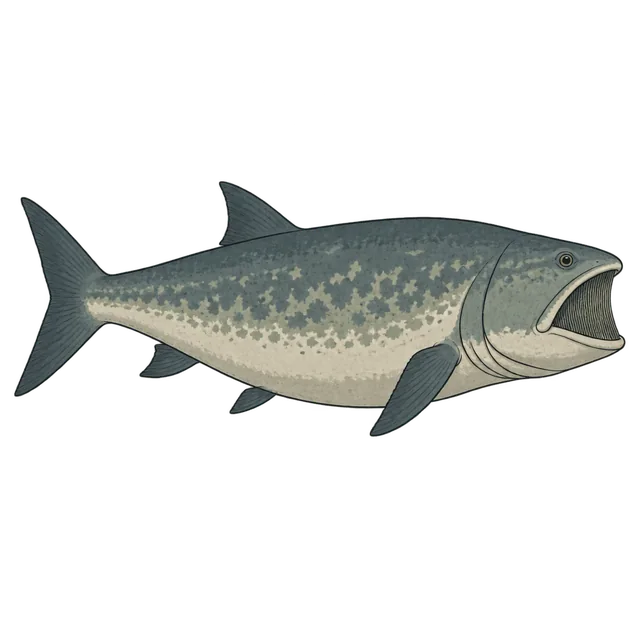
As a Leedsichthys you would be one of the largest bony fish that ever lived, cruising Jurassic seas with your mouth open, sieving up shrimp the way a whale shark does today.
Named after a farmer
Leedsichthys problematicus lived about 165 million years ago, in the Middle Jurassic. The first remains came from the Oxford Clay near Peterborough in England, collected in the 1880s by Alfred Nicholson Leeds, a gentleman farmer and avid fossil hunter, whose name the fish now carries. The species name, ‘problematicus’, is honest: its fossils are fragmentary, because much of the skeleton was cartilage that rarely fossilised. Remains are also known from France, Germany and Chile. Reconstructing it is therefore a puzzle assembled from gill rakers, fin rays, bits of skull and bony tail elements, compared with its smaller relatives in the family Pachycormidae.
How long, exactly?
Older claims of 25–30 metres did not survive detailed study. A 2013 analysis of growth rings in its bones estimated that large individuals typically reached around 8–16.5 metres, taking some 40 years to get there. Even the lower figure makes it one of the biggest bony fishes known. Hundreds of thousands of fine, comb-like gill rakers would strain tiny animals – crustaceans, jellyfish, fish larvae – from the water as you swam. The mouth would open wide like a scoop, and water would pass out through the gills while food stayed trapped inside.
Life of a slow giant
This was not a hunter’s life. You would follow plankton blooms, probably across long distances and perhaps in seasonal patterns, much as modern basking sharks do. Being big and slow carried risks: fossils from the Oxford Clay show Leedsichthys bones with bite marks, likely from pliosaurs such as Liopleurodon or the marine crocodile relative Metriorhynchus, though some marks may be from scavenging. It is one of the earliest known giant filter feeders among vertebrates, a role later taken by baleen whales.