Ammonite
As an ammonite you would live inside a coiled shell of your own making, adjusting your buoyancy like a tiny submarine and peering out at a sea full of things that wanted to crack you open.
Not a snail
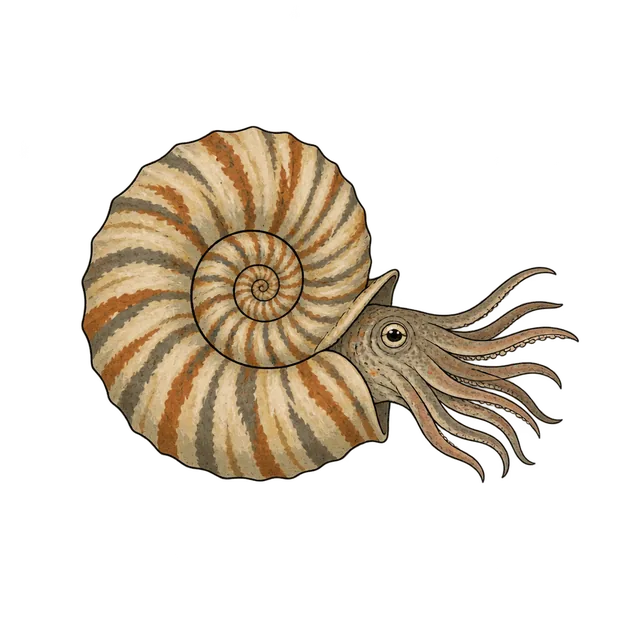
Ammonites were cephalopods – relatives of squid, octopus and cuttlefish, more closely related to them than to the living nautilus, which only looks similar. The group appeared in the Devonian, around 400 million years ago, survived several mass extinctions by a thread, and in the Mesozoic diversified into thousands of species. Most were a few centimetres to tens of centimetres across; the giant Parapuzosia seppenradensis from Germany has a shell about 1.75–1.8 metres wide even with part of it missing.
Because species evolved quickly and spread widely, ammonites are among the most important index fossils: geologists use them to date Mesozoic rocks, sometimes to within a few hundred thousand years.
Living in a shell
The shell was divided into chambers. You would occupy only the last and largest, the body chamber; the rest were filled with gas and liquid, connected by a tube called the siphuncle, which let you adjust buoyancy. The walls between chambers met the outer shell along complex, frilly ‘suture lines’, a hallmark of ammonites. Most were probably slow swimmers, jetting water like squid, and fed on plankton and small animals. Some, called heteromorphs, had uncoiled, hooked or even knotted shells.
Dangers and the end
Predators included fish, marine reptiles and other cephalopods; many fossil shells show bite marks or repaired damage. Young ammonites hatched tiny, part of the plankton, which may explain their downfall: when the asteroid struck 66 million years ago and ocean surface ecosystems collapsed, plankton-dependent young would have been hit hard. The ammonites, after more than 330 million years, disappeared, while the nautiluses, with larger eggs and slower lives, survived.