Medieval herald
As a herald you would be the walking encyclopedia of who was who – able to name a knight at a glance from the colours painted on his shield.
Experts in arms
Heraldry – the system of hereditary coats of arms – developed in western Europe during the 12th century, partly because knights in helmets were hard to recognise. Heralds began as announcers and messengers at tournaments, and their knowledge of arms made them the natural experts. They learned blazon, the technical language for describing arms, with its colours (tinctures) such as gules for red and azure for blue, and kept rolls of arms – illustrated lists of the coats of particular knights and families.
On the battlefield
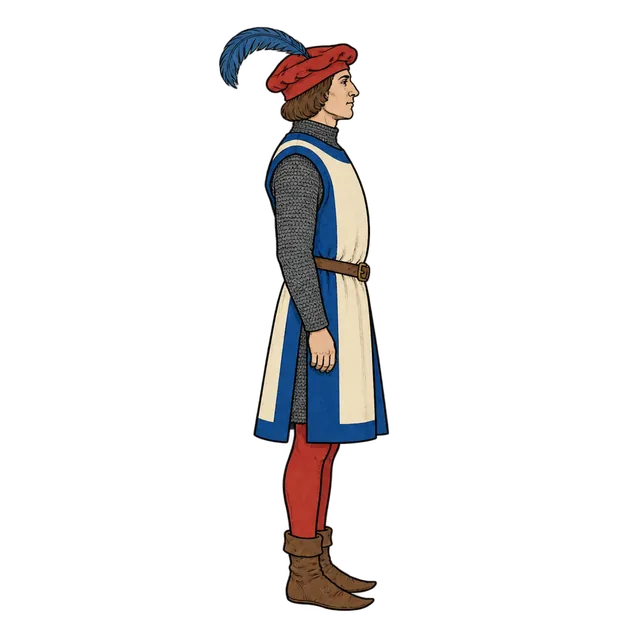
Heralds wore a tabard with their lord’s arms and enjoyed a form of diplomatic immunity. They carried challenges and messages between opposing commanders, proclaimed truces and called for surrenders. After a battle, they walked the field identifying the dead nobles by their arms – after Agincourt in 1415, heralds from both sides are said to have watched the fighting together and counted the fallen. They also judged disputes over who had the right to bear certain arms. Before Grunwald in 1410, according to Jan Długosz, two heralds of the Teutonic Grand Master brought King Jogaila two bare swords as a provocation to fight.
Ranks and records
Over time heralds became organised officials. In England they formed a hierarchy of kings of arms, heralds and pursuivants, incorporated as the College of Arms in 1484, which still grants arms today. Polish heraldry developed differently: arms usually belonged to whole clans rather than individual families, many with names such as Leliwa, Topór or Nałęcz, and heralds played a smaller role. The 15th-century armorial compiled by the chronicler Jan Długosz, describing the arms of Polish knightly clans, is a key source.