Archelon
As an Archelon your flippers would span about four metres – the width of a small car – and you would still have to drag yourself up a beach to lay your eggs.
The biggest turtle on record
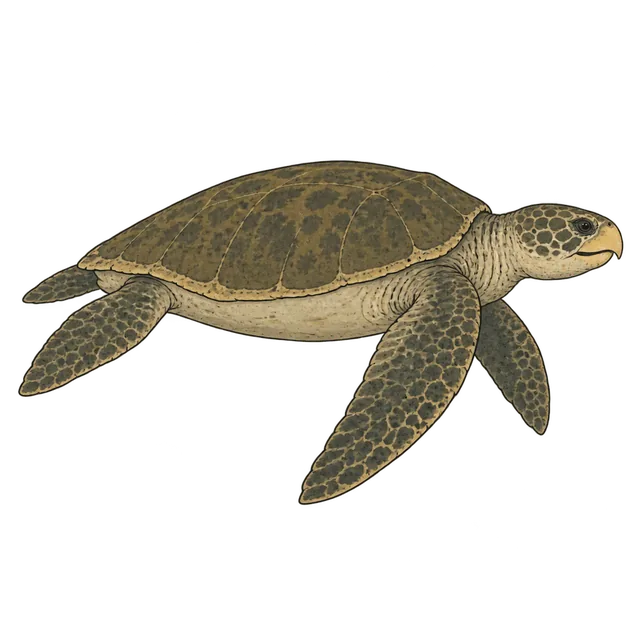
Archelon ischyros lived about 80 to 74 million years ago in the Western Interior Seaway, with major fossils from the Pierre Shale of South Dakota. It was named in 1896 by George Reber Wieland, and the name means ‘ruler turtle’. The largest known specimen, at the Natural History Museum in Vienna, is about 4.6 metres long and roughly 4 metres across the flippers; its weight is usually estimated at around 2 tonnes.
It was a turtle – a reptile, but not a dinosaur – and most researchers place it close to the ancestry of today’s leatherback turtle, although that is debated.
A shell full of holes
Unlike most turtles, Archelon did not have a solid shell. Its carapace was a framework of bony ribs, probably covered in thick, leathery skin, much like a leatherback’s. That saved weight and suited life in open water. The head was long, with a hooked, beak-like snout that, combined with powerful jaws, may have been used for crushing shelled prey such as ammonites and other molluscs, or for eating jellyfish and floating plants. Its diet is inferred from its anatomy rather than from stomach contents.
Big but not untouchable
The Vienna specimen is missing its right rear flipper, possibly bitten off by a predator such as a mosasaur or a large shark, although it may also have been lost after death. As a female, you would have to haul yourself onto a beach to lay eggs, leaving the hatchlings to make it to the sea alone – a stage when most would be eaten. Growth studies on related turtles suggest an adult could live for decades.