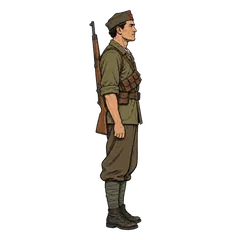
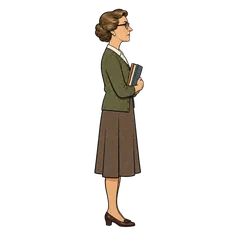
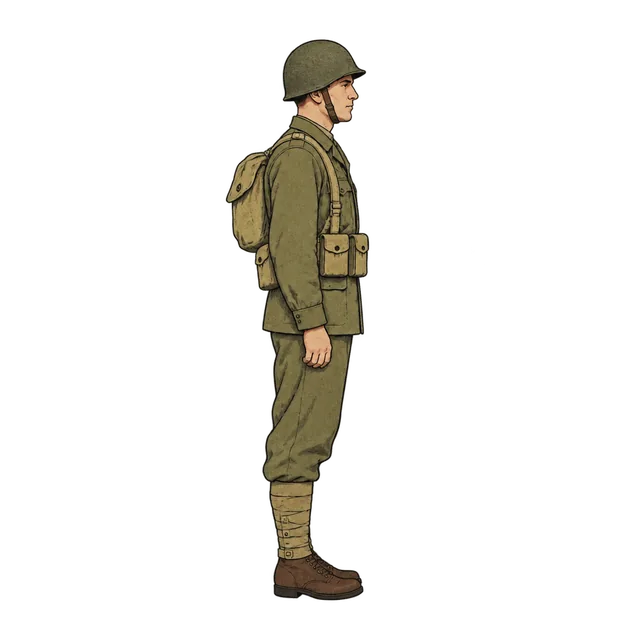
Infantry soldier
As an infantry soldier you would spend most of your time digging, carrying, waiting and trying to keep your feet dry – punctuated by moments of sheer terror.
Life in the trenches
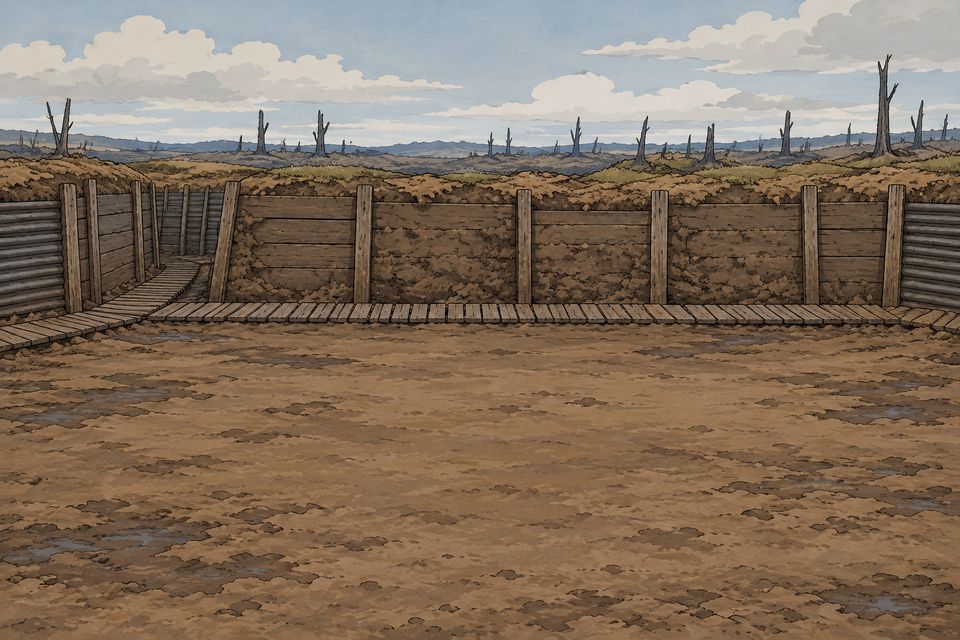
The First World War defined the image of the 20th-century foot soldier. On the Western Front, from late 1914 to 1918, armies faced each other across no man’s land from systems of trenches stretching from the Channel to Switzerland. Soldiers rotated between front line, support and reserve trenches, typically spending only days at a time in the front line. Daily life meant sentry duty, repairing parapets, hauling supplies at night, rats, lice and mud. Standing in cold water caused ‘trench foot’, which could lead to amputation.
Artillery caused the majority of wounds. Machine guns, barbed wire and shellfire made attacks across open ground murderous: on the first day of the Battle of the Somme, 1 July 1916, the British Army suffered around 57,000 casualties, including some 19,000 dead. Poison gas, first used on a large scale at Ypres in 1915, added a new horror.
A different war in 1939–1945
The Second World War was more mobile, with tanks, aircraft and motorised transport, but infantry still did most of the fighting and dying. Soldiers marched enormous distances, fought in cities, forests and mountains, and faced shortages of food and winter clothing. Combat stress, then called ‘shell shock’ or ‘battle fatigue’, was widespread.
Polish soldiers fought from the first day, 1 September 1939, then on many fronts: in Norway, France, North Africa, Italy – including the capture of Monte Cassino in May 1944 – and in the Normandy campaign, as well as with the Polish army formed in the USSR.
The ordinary soldier
Most soldiers were conscripts – young men taken from farms, factories and offices, given weeks or months of training. Letters home, food parcels, card games and friendships within the unit kept them going. Many who survived carried physical and psychological wounds for life.