20th-century scientist
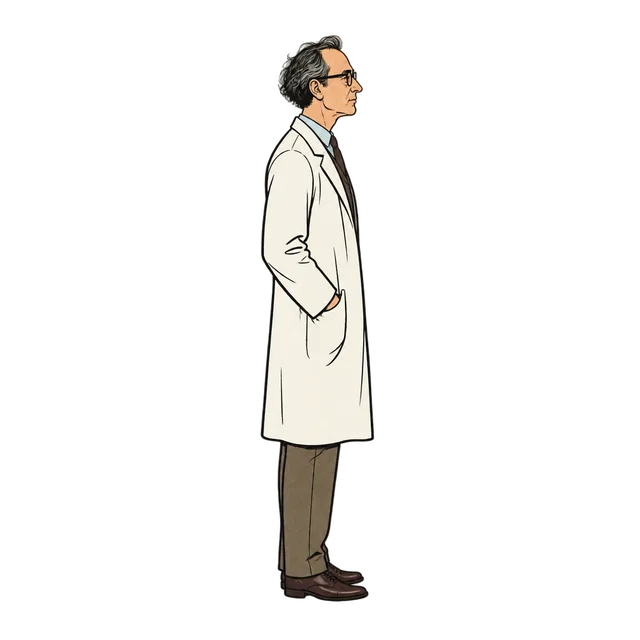
As a 20th-century scientist you would work in the century that split the atom, decoded DNA and launched satellites – and might face hard choices about what your discoveries were used for.

A century of breakthroughs
Few eras changed science so fast. Einstein published special relativity in 1905, quantum mechanics took shape in the 1920s, and nuclear fission was discovered in 1938. Penicillin (1928), the structure of DNA (1953), the first satellites (1957) and the transistor (1947) all reshaped daily life. The scientist’s workplace changed too: from a professor with a few assistants to large laboratories, research institutes and international collaborations such as CERN, founded in 1954.
A working day in the lab
Daily work mixed experiment, calculation and reading. Results were written in notebooks by hand, calculations done with slide rules and mechanical calculators until computers spread from the 1950s onward, and papers were typed, mailed to journals and peer-reviewed. Conferences, letters and later international visits were the main ways ideas spread. Funding increasingly came from governments, and the Cold War poured money into physics, space and computing. In the Eastern Bloc, contact with Western colleagues depended on passports and political approval, and some fields were bent by ideology – Soviet genetics suffered for decades under Lysenko.
Science and its shadows
War tied science to power. The Manhattan Project brought together thousands of scientists to build the atomic bomb, used on Hiroshima and Nagasaki in 1945. Under Nazi and Stalinist regimes, scientists were persecuted, and some took part in crimes.
Polish science gave the century major figures: Maria Skłodowska-Curie, the first person to win two Nobel Prizes (1903 and 1911), discovered polonium and radium with Pierre Curie. Polish mathematicians Marian Rejewski, Jerzy Różycki and Henryk Zygalski broke the German Enigma cipher in the 1930s and handed their methods to the British and French in 1939. Women scientists, like Skłodowska-Curie, faced exclusion that slowly eased over the century.