Three-toed sloth
As a three-toed sloth you would move so little that algae would grow in your fur – and a meal of leaves could take weeks to digest.

Living upside down
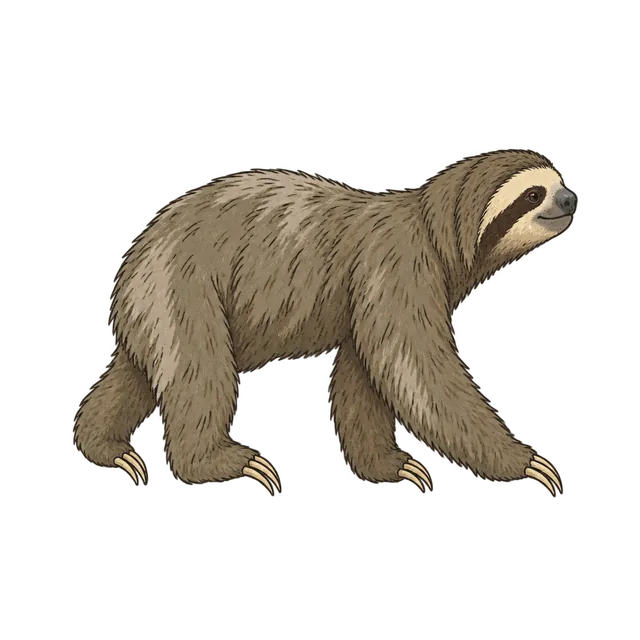
Three-toed sloths, genus Bradypus, live in the tropical rainforests of Central and South America. The brown-throated three-toed sloth is the most widespread species, from Honduras to northern Argentina. You would weigh about 3.5–4.5 kg, with long arms tipped with three curved claws, and spend almost your entire life in the canopy, hanging beneath branches. Your hair grows in the opposite direction to most mammals, from belly to back, so rain runs off while you hang upside down.
Three-toed sloths have extra neck vertebrae, usually eight or nine instead of the seven typical of mammals, letting you turn your head up to about 270 degrees.
The slow lane
You would eat leaves from a limited range of trees, which are low in energy and full of toxins. A large, multi-chambered stomach with bacteria breaks them down slowly; digestion can take days to weeks. To save energy, sloths have an unusually low metabolic rate and body temperature that rises and falls with the surroundings. You typically move only a few dozen metres a day, and your slowness also makes you hard for eagles to spot.
Your fur is an ecosystem. It hosts green algae, which help camouflage you, plus moths, beetles and fungi. Some of these fungi are being studied for compounds with possible antibacterial activity.
The weekly trip to the ground
Roughly once a week, you climb down to the forest floor to urinate and defecate, a strange and risky habit since you are most vulnerable to jaguars and ocelots on the ground. Scientists still debate why sloths do this. Mothers give birth to a single young, which clings to the mother for about six months. Harpy eagles are major predators, along with jaguars, ocelots and snakes. Threats from humans include deforestation, power lines, road traffic and the illegal pet trade. Wild three-toed sloths are thought to live a few decades, though reliable data are limited. Despite the cliché, sloths do not sleep 20 hours a day; field studies suggest closer to 10.