Radio operator
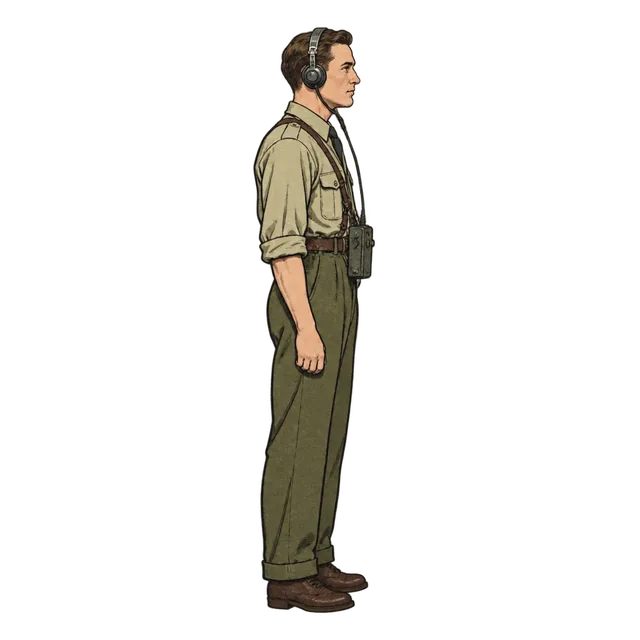
As a radio operator you would carry the army’s voice on your back – and know that every transmission could tell the enemy exactly where you were.
Dots, dashes and static
Radio transformed warfare in the 20th century. In the First World War sets were heavy and used mainly at higher headquarters, while front-line units still relied on telephone wire, runners, signal lamps and even pigeons. By the Second World War, portable sets – carried on a soldier’s back or mounted in tanks and aircraft – connected units to each other and to artillery and air support. Operators sent and received messages mostly in Morse code, typically at 15–25 words per minute for a trained operator, and later increasingly by voice.
Codes and being hunted
Messages had to be encrypted, so operators worked with codebooks, cipher tables or, at higher levels, cipher machines. Mistakes in procedure could betray a whole network – the breaking of Enigma relied in part on operators’ careless habits. The enemy also used direction-finding: by triangulating a signal from two or more receivers they could locate a transmitter. Operators behind enemy lines, such as agents and resistance radio men, were often caught this way, and their life expectancy in occupied countries could be tragically short. Keeping transmissions brief and moving between locations was a matter of survival.
The voice of the Uprising
During the Warsaw Uprising of 1944, the Home Army ran the radio station Błyskawica (‘Lightning’), which broadcast from 8 August in Polish and other languages, informing the world about the fighting. Polish signals experts had already made a major contribution in the Polish–Soviet War of 1920, when radio intelligence broke Soviet ciphers and helped win the Battle of Warsaw. In everyday life, though, a radio operator’s war meant cold, fatigue, aching hands and long hours with headphones, listening through static for the faint signal that mattered.