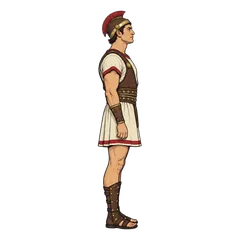
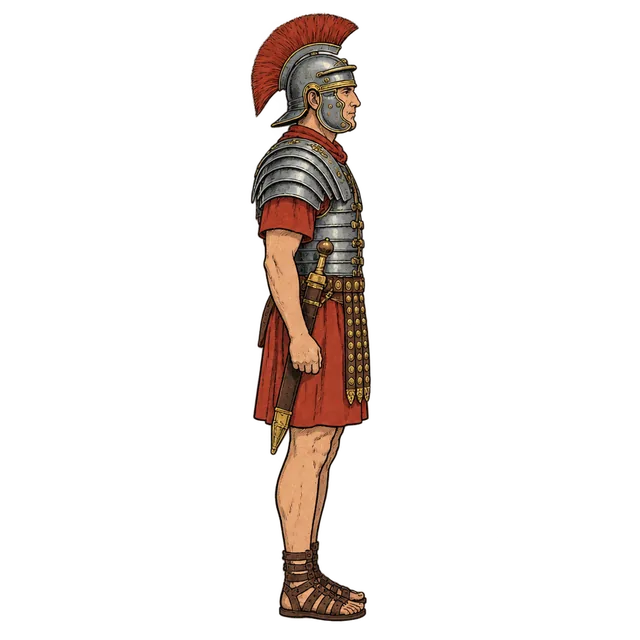
Roman legionary
Signing up as a legionary meant giving Rome a quarter of a century – most of it spent not fighting but marching, digging and waiting.

A career, not a campaign
Under Augustus the army became a standing professional force. Legionaries were Roman citizens, usually enlisting in their late teens or early twenties, and eventually served 25 years. A legion numbered roughly 5,000 men, divided into centuries of 80 led by centurions; eight soldiers shared one tent and one mule as a contubernium.
Pay was steady rather than generous – 225 denarii a year under Augustus, raised to 300 under Domitian – and deductions for food, kit and burial club came out of it. On discharge a veteran received a cash bonus or a plot of land.
Mostly walking and shovelling
Roman soldiers were famous for their marching. Military writer Vegetius describes a standard pace of 20 Roman miles, about 30 kilometres, in five summer hours, carrying weapons, rations, tools and a stake for the palisade. At the end of each day’s march, the army built a fortified camp from scratch.
In peacetime legionaries built roads, bridges, aqueducts and walls; Hadrian’s Wall was largely their work. The Vindolanda tablets from northern Britain record ordinary concerns: requests for leave, birthday invitations, and a parcel containing socks and underpants.
Discipline and danger
Discipline was harsh: centurions carried a vine staff for beatings, and a unit that fled in battle could be decimated, one man in ten executed by lot, though this was rare in the imperial period. Legally, serving soldiers were forbidden to marry until the reign of Septimius Severus around 197 CE, so many kept unofficial families near the fortress.
Disease and accidents probably killed more men than combat, but defeats could be devastating: in 9 CE three entire legions were wiped out in the Teutoburg Forest in Germania.