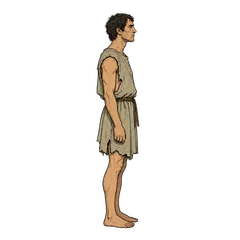
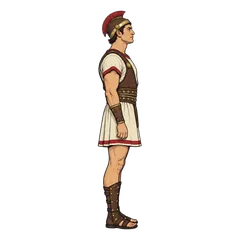
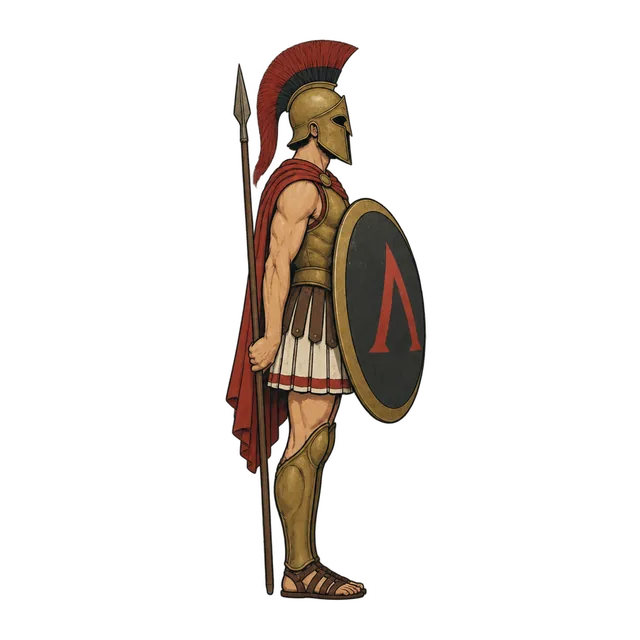
Greek hoplite
As a hoplite you would be a farmer most of the year – and, when the call came, a man in bronze standing shoulder to shoulder with his neighbours, trusting their shields as much as your own.
Citizen, farmer, soldier
Hoplites were the heavy infantry of the Greek city-states from roughly the 7th to the 4th century BCE. In most cities they were not professionals but property-owning citizens who bought their own equipment. That made the hoplite class politically important: the men who fought for the polis expected a say in running it.
Sparta was the great exception. There, full citizens were forbidden manual work and trained for war from childhood, while the land was farmed by the helots, an enslaved population.
Carrying the panoply
Your gear, the panoply, was heavy: a bronze helmet such as the Corinthian type, which covered most of the face and muffled hearing; a breastplate of bronze or layered linen; greaves; a thrusting spear around 2–2.5 metres long; a short sword; and above all the aspis, a round shield about 90 centimetres across, made of wood faced with bronze. Estimates put the full kit at roughly 20–30 kilograms, so wealthier hoplites brought an attendant to carry it on the march.
The shield had a central armband and a grip at the rim, so it protected your left side and half of the man to your left. That is why breaking ranks endangered everyone and why throwing away your shield was the ultimate disgrace.
Battle in the phalanx
Battles were short, brutal collisions of dense formations, often eight ranks deep. How exactly they worked – whether rear ranks literally shoved the front ones forward, the othismos – is still argued over by historians. Campaigns were usually brief and timed around the harvest. Famous hoplite victories include Marathon in 490 BCE, where Athenians and Plataeans defeated a Persian landing force, and the stand at Thermopylae in 480 BCE.