Elasmosaurus
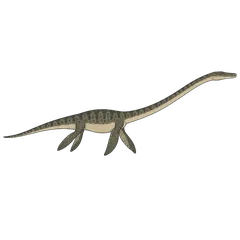
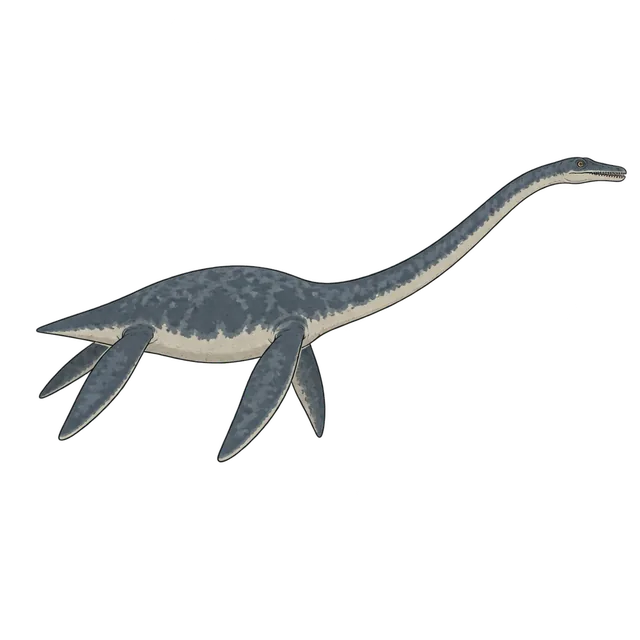
As an Elasmosaurus, more than half of your ten-metre body would be neck: a living fishing rod with a small, toothy head at the end.
Mostly neck
Elasmosaurus swam in the Western Interior Seaway about 80 million years ago; its only good skeleton was found in western Kansas in 1867. It was a plesiosaur – a marine reptile, not a dinosaur – and an extreme one. Of its roughly 10 metres, about 7 were neck, built from 72 vertebrae, more than almost any other known animal. Four long flippers, beaten in an underwater ‘flying’ stroke rather than rowed, drove a broad, compact body. Big sharks and mosasaurs were the main threats.
How to use a neck like that
Old illustrations show elasmosaurs holding their heads high above the water like swans. Studies of the neck joints show this was impossible: the neck bent little upwards and more easily sideways and down. More likely, you would cruise slowly and ease your head into schools of small fish or squid-like prey before the bulky body could scare them off. Elasmosaurids also swallowed stones; these gastroliths may have served as ballast or helped to grind food.
Plesiosaurs gave birth to live young. A fossil of the related Polycotylus contains a single large embryo, suggesting one big baby at a time and perhaps parental care.
The head on the wrong end
Elasmosaurus is also famous for a human mistake. Edward Drinker Cope, reconstructing the skeleton in 1868–69, put the skull on the end of the tail, assuming the longest part must be the tail. Joseph Leidy pointed out the error, and Cope’s rival Othniel Marsh happily spread the story for years. Cope tried to buy back copies of the flawed publication, and the episode fed the bitter feud known as the ‘Bone Wars’.