Carnotaurus
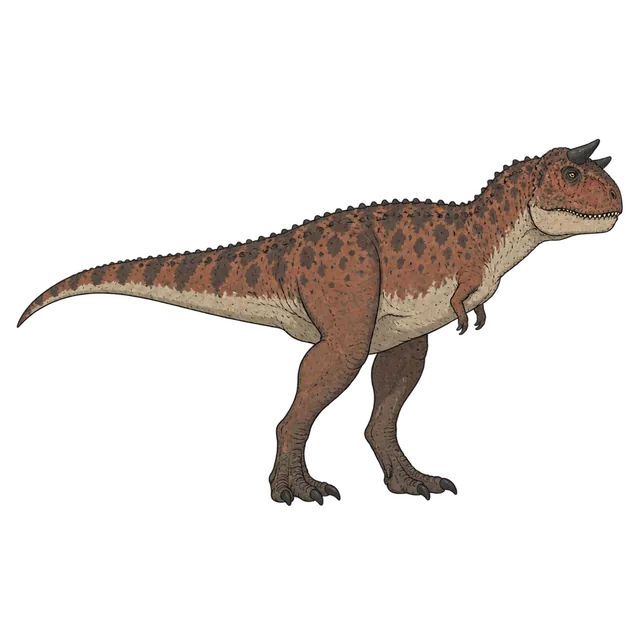
As a Carnotaurus you would be the bull-horned sprinter of Late Cretaceous Patagonia: fast in a straight line, clumsy in the turns, and equipped with arms so small they barely counted.
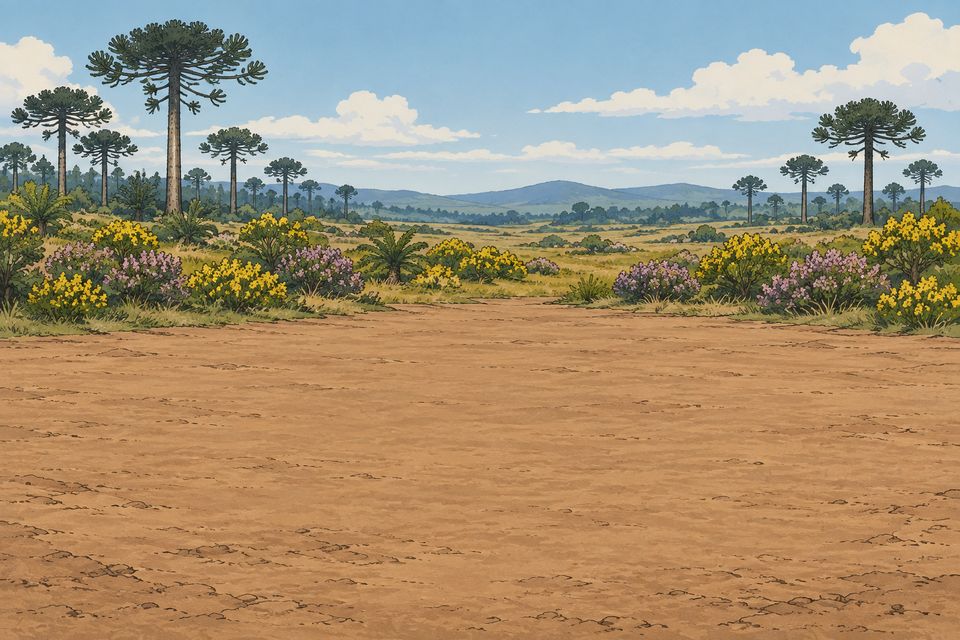
Patagonia near the end
You live around 72–69 million years ago in what is now Chubut Province, Argentina. The La Colonia Formation, where your only known skeleton was found, records a coastal landscape of estuaries, tidal flats and lagoons. South America had been isolated for millions of years, and its top predators were abelisaurids like you rather than tyrannosaurs.
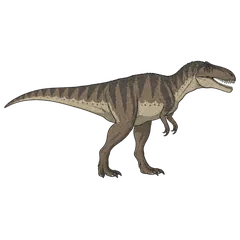
You are about 7.5–8 metres long and probably 1.3–2 tonnes, with a short, deep skull and a thick horn above each eye.
Built for speed
Your tail held enormous muscles that pulled the thighs backwards, and studies of these muscles suggest you were among the fastest large theropods – but with a stiff tail and body, you likely turned slowly. Your arms were extremely reduced, with stubby forearms and fingers that could hardly grasp anything.
With a fairly weak but quick bite, you may have specialised in rapid snaps at smaller prey. The horns were probably for display or head-to-head shoving contests with rivals.
A skin you can still see
The skeleton, found by José Bonaparte’s team in 1984, preserves large patches of skin impressions. They show a background of small, non-overlapping scales with scattered larger, cone-shaped scales in rows – and no sign of feathers. Carnotaurus is one of the best-documented examples of what a big theropod’s skin really looked like.
Your eyes faced partly forward, which may have given you some depth perception, and your neck was strongly muscled. Like other abelisaurids, you belonged to a family that dominated the southern continents – South America, Africa, India and Madagascar – in the Late Cretaceous.