Honey bee
As a honey bee you would have a career plan fixed from birth: housekeeper, nurse, builder, guard and finally forager – all within about six summer weeks.
A job for every age
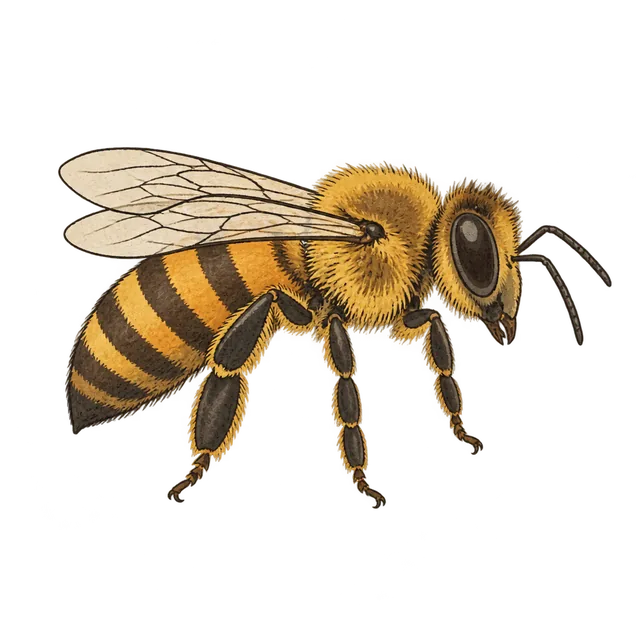
Honey bees (Apis mellifera) are kept by beekeepers on farms, meadows and even city rooftops, so you would most likely live in a wooden hive with 20,000 to 60,000 sisters in summer. Almost all are sterile female workers; a single queen lays the eggs, and a few hundred males, the drones, wait for a chance to mate.
Your tasks follow your age. In the first days you clean cells; then you feed larvae with secretions from glands in your head; around two weeks old you produce wax and build comb, process nectar and guard the entrance. From about three weeks you fly out to forage, usually within a few kilometres of the hive.
Talking with your body
When you find a rich patch of flowers you return and perform the waggle dance on the comb. The angle of the waggle run relative to vertical shows the direction of the food relative to the sun, and its duration indicates distance. Karl von Frisch shared the 1973 Nobel Prize in Physiology or Medicine partly for decoding it.
You see ultraviolet patterns on petals that humans cannot, and you carry pollen home in baskets on your hind legs. Your whole life’s work adds up to roughly a twelfth of a teaspoon of honey.
Short summers, long winters
A summer worker wears out in about five to six weeks; bees born in autumn can survive the winter for several months, clustering and shivering to keep the queen warm. Stinging a mammal is usually fatal, because the barbed sting tears away. Drones are pushed out of the hive in autumn. Threats include birds, spiders, pesticides, Varroa mites and the viruses they spread.