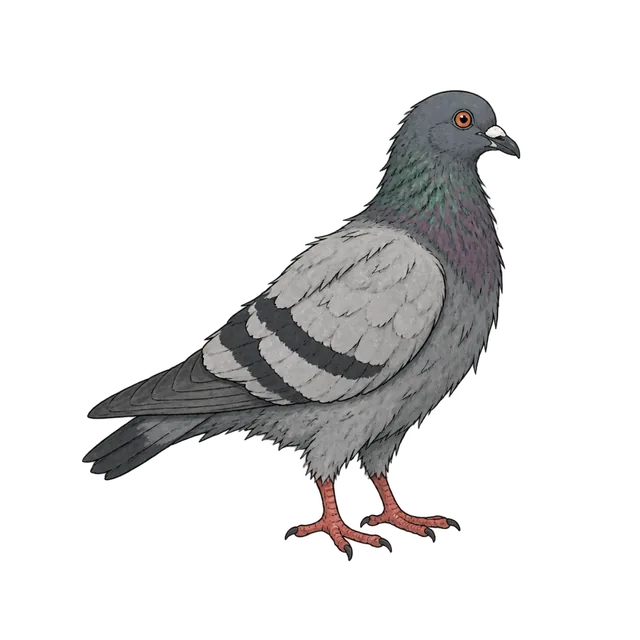
Urban pigeon
As a city pigeon you would treat window ledges as sea cliffs – because, as far as your instincts are concerned, that is exactly what they are.

A cliff bird in a concrete world
Feral pigeons are descendants of the rock dove, Columba livia, a wild bird of sea cliffs and rocky gorges that people domesticated thousands of years ago for meat, messages and fancy breeding. Escaped and released birds founded the flocks that now live in almost every city on Earth. Building ledges, bridges, station roofs and the balconies of apartment blocks are a convincing substitute for cliffs, and street food is plentiful.
You would weigh around 300–350 g. Your plumage could be the classic blue-grey with two dark wing bars, or chequered, reddish, white or patchy, a legacy of domestic breeding. The iridescent green and purple on your neck comes from the structure of the feathers, not pigment.
Family life on a ledge
Pigeons usually pair for life and can breed in almost any month. The nest is a careless platform of twigs, often on top of old nests and droppings. Both parents incubate two white eggs for about 18 days. Newborn squabs are fed crop milk, a nutritious secretion from the lining of the parents’ crop – something both males and females produce, which is rare among birds.
That is why baby pigeons are rarely seen: they stay hidden in the nest for about a month and leave looking almost like adults.
Navigator and survivor
Pigeons find their way home using the sun, the Earth’s magnetic field, smells and familiar landmarks, an ability exploited by message-carrying pigeons in both world wars. City life brings hazards: peregrine falcons and goshawks, cats, cars, injured feet tangled in hair and thread, and poor diets of bread. Wild feral pigeons typically live only a few years, although well-kept domestic pigeons can exceed fifteen.