Eurasian beaver
As a beaver you would be one of the few animals that redesign their whole landscape – flooding a valley because you prefer your front door underwater.

A rodent built for water
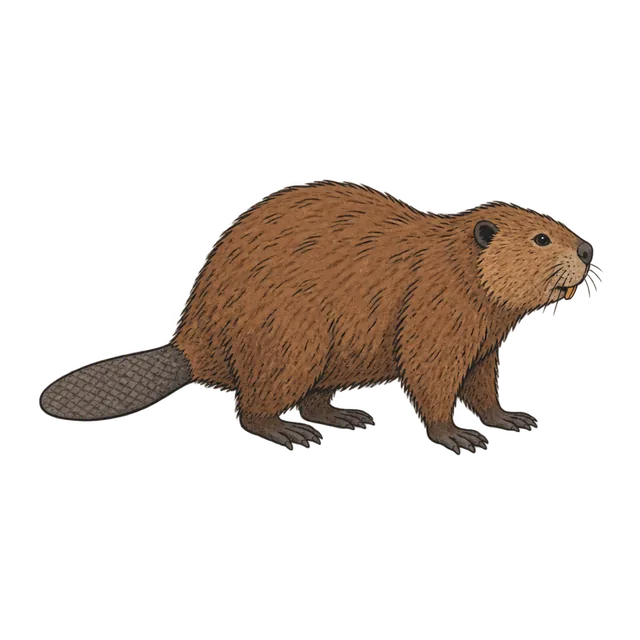
The Eurasian beaver, Castor fiber, is Europe’s largest rodent: adults weigh around 18–30 kg and measure about a metre including the flat, scaly tail. You would have webbed hind feet, valves that close your ears and nostrils, transparent membranes over your eyes and lips that close behind your incisors so you can gnaw underwater without swallowing water.
Those incisors never stop growing and are orange because the enamel contains iron, which makes it harder. You would live on rivers, streams, lakes and wetlands, eating bark, twigs and leaves of willow, aspen and poplar, plus water plants and herbs in summer.
Engineer on night shift
Beavers are mostly nocturnal. You would fell trees by gnawing a cone-shaped notch, then cut branches and drag them to the water. Where the water is too shallow, you build dams of wood, mud and stones to raise the level, so that the entrance to your home stays submerged and safe from predators. Your home is either a burrow dug into the bank or a lodge, a mound of branches and mud with a dry chamber above water level.
Before winter you sink a store of branches near the lodge to feed on under the ice. Beaver ponds trap sediment, slow floods and create habitat for fish, amphibians, insects and birds.
Family, scent and survival
Beavers live in families: a monogamous pair with young from the current and previous year. Usually two to four kits are born in spring; at about two years old they leave to find their own territory, which is marked with castoreum, a scented secretion. Hunted for fur and castoreum, the Eurasian beaver fell to perhaps 1,200 animals in a few isolated populations by around 1900. Protection and reintroductions brought a remarkable recovery; Poland now has well over 100,000. In the wild beavers live roughly 7–10 years, threatened by wolves, cars, floods and conflict with landowners.