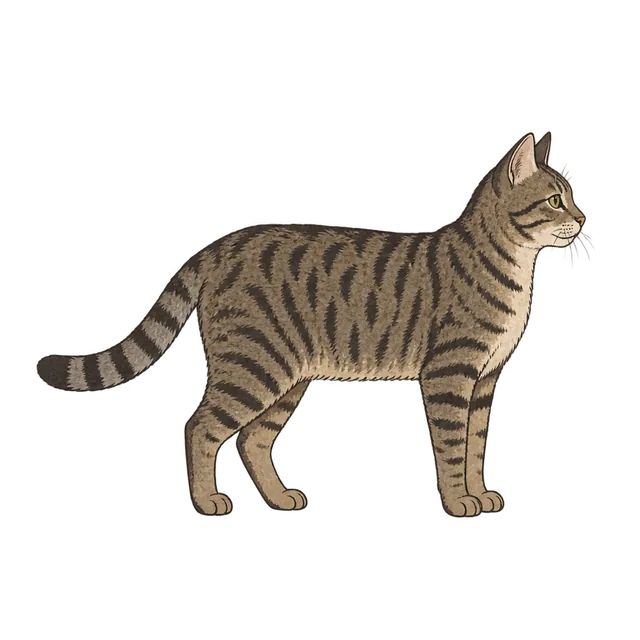
Tabby cat
As a tabby house cat you would sleep most of the day, own the warmest spot in the flat and still keep the instincts of a desert hunter.

A wildcat who moved in
Domestic cats descend from the African wildcat, Felis lybica. Cats began living alongside farmers in the Near East thousands of years ago, probably attracted by rodents in grain stores; a cat buried with a human on Cyprus about 9,500 years ago is among the earliest evidence. Tabby is not a breed but a coat pattern – stripes, swirls or spots, usually with an M-shaped mark on the forehead – and it is the original wild-type pattern.
You would weigh around 3.5–5 kg. Your eyes are built for dim light, with a reflective layer, the tapetum lucidum, that makes them shine at night. You can hear high-pitched sounds well beyond the range of human hearing, which is handy for detecting mice.
A day indoors
House cats commonly sleep 12–16 hours a day, more when young or old, and are most active at dawn and dusk. Even well-fed cats keep the urge to hunt; indoors it goes into stalking toys, socks and ankles. You would groom for a large part of your waking time with a tongue covered in backward-facing spines.
Adult cats rarely meow to one another; meowing is largely a way of talking to humans. Purring happens when content, but also sometimes when stressed or in pain. Slow blinking towards a person is a friendly signal, and studies suggest people can use it to build trust with cats.
A long, comfortable life
An indoor, neutered cat with good care often lives 12–18 years, with some passing 20. Outdoor cats live shorter lives on average, mainly because of traffic, fights and disease. In old age, kidney disease, hyperthyroidism and dental problems are common. Cats are obligate carnivores and need nutrients such as taurine found in meat. Free-roaming cats kill large numbers of birds and small mammals, which is why keeping them indoors or supervised is increasingly encouraged.