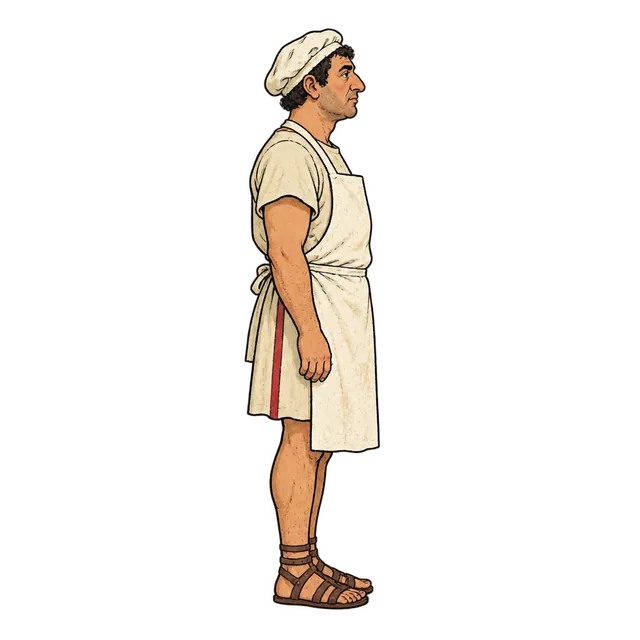
Roman baker
As a Roman baker you would start work long before dawn, feeding a city that ate bread at almost every meal – with donkeys, slaves and a scorching oven as your workforce.
From home cooking to a trade
According to Pliny the Elder, there were no professional bakers in Rome until the war with King Perseus in the 2nd century BCE; before that, women baked at home. By the imperial period the city had hundreds of bakeries, and since few apartments had ovens, most people bought their bread.
Bakeries usually did everything on site, from grinding grain to selling loaves. At Pompeii archaeologists have found more than 30 bakeries, many with large lava-stone mills shaped like hourglasses.
A day at the mill and oven
The work was heavy. Grain was ground by turning the upper stone of the mill around a fixed lower stone, pushed by donkeys, mules or human labourers – often enslaved – walking in circles for hours. Dough was kneaded by hand or in simple mechanical kneading machines. The domed oven, heated with wood, was swept out before the loaves went in.
Bakers produced different grades of bread, from coarse dark loaves for the poor to fine white bread for the rich. Several carbonised loaves survive from Pompeii, preserved by the eruption of Vesuvius in 79 CE. They are round and divided into eight segments, and a loaf from nearby Herculaneum bears a stamp naming Celer, slave of Quintus Granius Verus.
Profit, pride and the grain supply
Because bread mattered politically, bakers were tied ever more closely to the state grain supply, and in the later empire the trade became compulsory and hereditary. Some bakers grew rich. In Rome, the freedman Marcus Vergilius Eurysaces built a tomb near the Porta Maggiore in the later 1st century BCE decorated with a frieze showing every stage of bread-making – and with round openings that are often thought to resemble mixing vessels.