Plateosaurus
As a Plateosaurus you would be one of the first truly big dinosaurs, striding on two legs across a dry Triassic Europe some 210 million years ago.
Europe before the giants
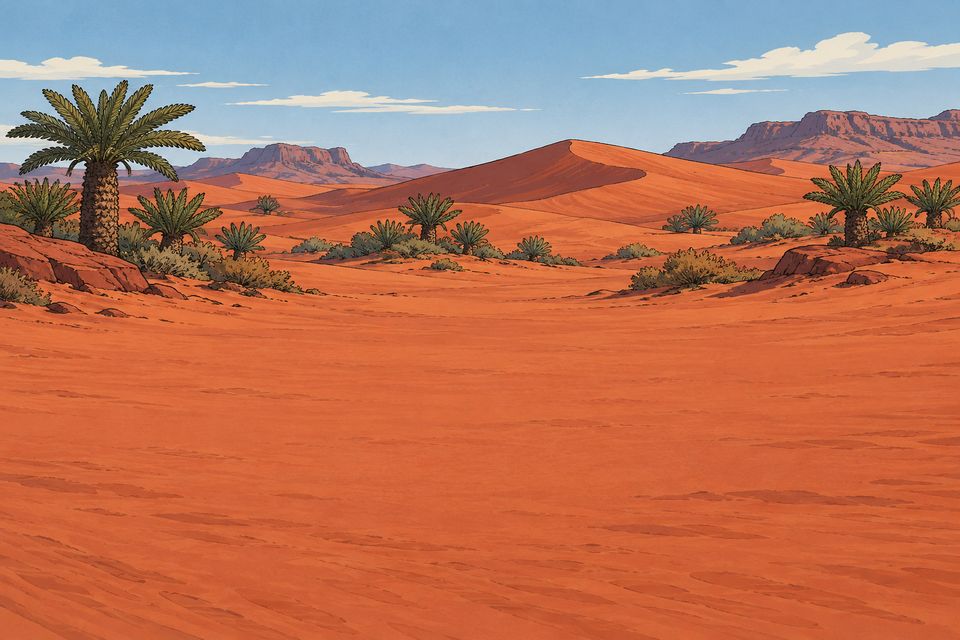
Plateosaurus lived in the Norian stage of the Late Triassic, roughly 214–204 million years ago, in a warm, seasonally dry landscape across what is now Germany, Switzerland and France. Hermann von Meyer named it in 1837, making it one of the first dinosaurs ever named.
It is also one of the best known: sites such as Trossingen in Germany and Frick in Switzerland have produced well over a hundred skeletons, many of them complete.
Two legs, not four
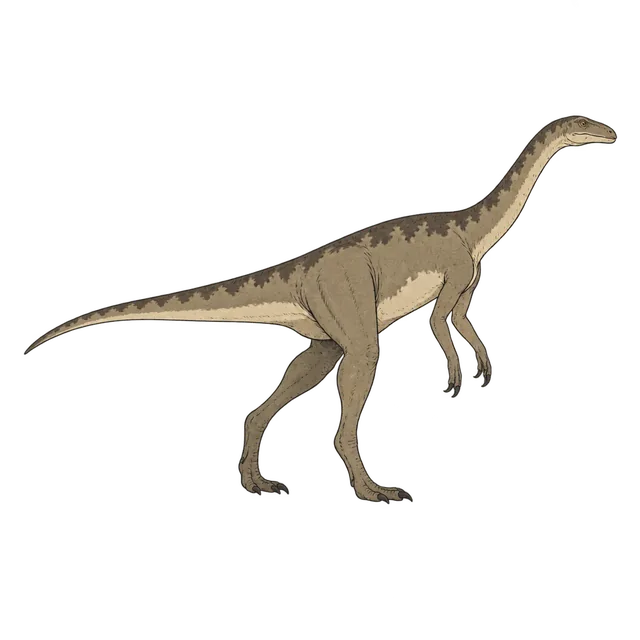
Plateosaurus was an early sauropodomorph – a distant forerunner of Brachiosaurus and Diplodocus – but it looked rather different: 5–10 metres long, with a long neck, a small head with leaf-shaped teeth and powerful hind legs. Studies of its forearm show the hands could not be turned palm-down, so it could not walk on all fours. Your hands, with a large thumb claw, were for grabbing branches and perhaps for defence.
Its teeth suit a mostly plant-based diet, though some researchers allow for the occasional small animal. Its neck had ten vertebrae and allowed you to browse from ground level up to a few metres high, giving Plateosaurus access to food that smaller Triassic plant-eaters could not reach.
Growing up flexibly – and stuck in the mud
Bone histology has revealed something unusual: adult Plateosaurus varied hugely in size, with some fully grown individuals barely half the length of others. Growth appears to have depended on conditions – food, climate – much as in modern reptiles, rather than following a fixed schedule as in birds and mammals.
Many of the famous skeletons are probably animals that sank in soft mud and could not pull themselves free. That would be the inglorious end of many a Plateosaurus life.