Diplodocus
Life as a Diplodocus means being longer than a tennis court is wide, yet light for your size – mostly neck and tail, with a head no bigger than a horse’s.

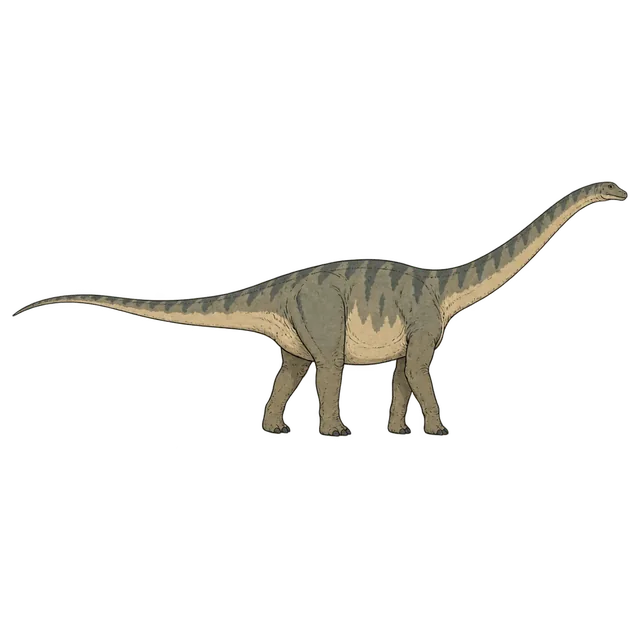
Mostly neck and tail
Diplodocus roamed the Late Jurassic floodplains of the western United States, roughly 154–152 million years ago. Diplodocus carnegii reached about 24–26 metres yet weighed perhaps 12–16 tonnes – slender by sauropod standards. Its larger relative D. hallorum, once called Seismosaurus, may have exceeded 30 metres.
The tail alone held around 80 vertebrae and ended in a thin whip. The name, “double beam”, refers to the paired chevron bones under the tail that may have protected blood vessels when the tail touched the ground. Recent finds of skin impressions suggest a row of narrow, keratin-covered spines running along the midline of the back and tail, which would give you a slightly frilled outline.
Grazing with a rake
Your mouth would hold a row of thin, pencil-like teeth at the front of the jaws only. Rather than chewing, Diplodocus probably raked or stripped soft leaves, ferns and horsetails, sliding the teeth through vegetation. Wear on the teeth was heavy, and studies of their growth lines suggest each tooth was replaced roughly every month.
Whether you browsed high or low is still argued over. Neck studies suggest a fairly horizontal posture, with the reach working sideways across a wide feeding arc, though rearing on the hind legs to reach higher may have been possible.
Dippy goes on tour
In 1899 a skeleton was dug up in Wyoming for steel magnate Andrew Carnegie, and in 1901 it was named Diplodocus carnegii. Carnegie then had plaster casts made and presented them to museums around the world, from London and Paris to Berlin, Vienna, Madrid and La Plata. The London cast, “Dippy”, stood in the Natural History Museum’s main hall from 1979 until 2017, before touring the UK.
Few dinosaurs have been seen by so many people – you would be one of the best-known faces of the Mesozoic.