Roman augur
As an augur you would spend your career watching the sky for birds – and that apparently harmless hobby could cancel an election or stop an army in its tracks.

Asking permission, not predicting the future
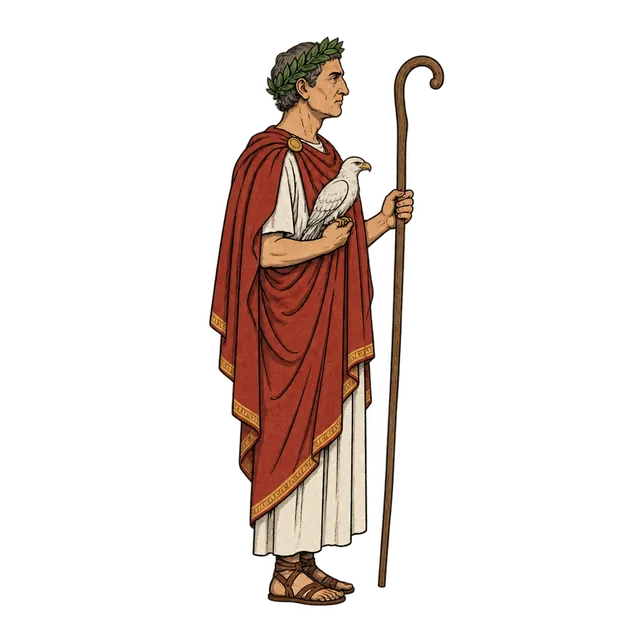
Augurs formed one of Rome’s major priestly colleges, traditionally dating back to Romulus, who was said to have founded the city after seeing twelve vultures. Contrary to the popular image, augurs did not foretell the future in detail. Their job was to determine whether the gods approved or disapproved of a planned action – a meeting, an election, a battle – through signs called auspices.
The college grew over time, reaching 15 members under Sulla and 16 under Julius Caesar. Membership was for life and highly prestigious; Cicero became an augur in 53 BCE and later wrote a treatise, On Divination, questioning the whole practice.
How you would read the signs
Your symbol was the lituus, a staff curved at the top like a crook. With it you marked out a sacred area of sky, the templum, then sat facing it in silence and watched. You noted which birds appeared, from which direction, how they flew and what calls they made; ravens and crows were judged by their voices, eagles and vultures by their flight. Thunder and lightning also counted as signs.
On campaign, generals relied on sacred chickens kept in a cage. If they ate greedily, dropping grain, the sign was good. Famously, in 249 BCE the consul Publius Claudius Pulcher threw the chickens overboard when they refused to eat, saying that they could drink instead – and then lost the naval battle of Drepana.
A political veto in a toga
Because public business required favourable auspices, an augur’s announcement that the signs were bad could postpone an assembly. Politicians exploited this: in 59 BCE the consul Bibulus withdrew to his house and declared he was watching the sky, trying to invalidate all Caesar’s legislation. The college survived into the 4th century CE, until the Christian emperors ended the state cults.